In the bottom drawer, beneath old guarantees,I find my father's last letter,its envelope freckled with pale abrasions,the gum along the flap eaten through.
A silverfish slips from the fold,a quick stroke of mercury,three fine hairs trailing behindas it disappears beneath the lining.
I remember the careful capitals of my name,his habit of underlining datesas though they might otherwise escape us.Three pages in the small, compressed handthat made every sentence look economical.
I read them once, folded them twiceand put them where I would not have to answer.
Now whole words have gone,small islands of daylightopening between his sentences.
I can still make out I never meantand, further down, you must understand,but nothing of what lay between.
I hold the pages against the window,turning them slowly towards the light.Beneath the drawer, something movesthrough the dust of his remaining words.
Martina made her small discovery about Stella’s eyes on one afternoon when the entire village was asleep. It was August. The heat hung over the yards, motionless and invisible, and no one passed along the road. In her grandmother’s house the curtains were drawn. Her grandfather was snoring softly in the little room where they kept the jars and the old wicker basket of walnuts from the previous fall, and her grandmother lay in the bedroom with a wet cloth on her forehead. Before falling asleep, she had told Martina that she was not allowed to go outside until a shadow fell across the doorstep. She had locked the front door, but Martina climbed through the window.
A wire fence separated the two houses. Beside it, in Stella’s yard, grew two enormous red currant bushes, and next to them an apricot tree with a whitewashed trunk. Its branches cast dappled shade over the bushes. Several rows of vines stretched behind the apricot tree and the currants. Stella’s yard sat a little higher, and from her own side of the fence, Martina could see Stella’s legs between the bushes.
“Can I come over?” Martina whispered.
“Only if you keep quiet.”
Stella was sitting on an overturned bucket, stripping the red berries off by the handful. She wore her cousin’s faded yellow T-shirt, which hung almost to her knees. Her hair was tied up messily, and a thin scratch ran across one cheek.
She pushed aside a board at the bottom of the fence with her foot. The wire mesh was loose there, leaving a wide gap. Martina lay down on her stomach, wriggled through, and stood up in the other yard, her elbows caked with dirt. Stella didn’t help her. She handed her a branch heavy with berries.
They ate without speaking. The currants were warm from the sun, and the tart juice stung their tongues. By the third handful, they could no longer taste anything, only the crunch of the tiny seeds between their teeth. Red juice ran down their fingers, bright and sticky.
Through the fence, Martina spotted a berry-laden branch reaching into her yard. She slipped back through, picked a few berries, and peeked at Stella through the leaves. Stella’s eyes looked perfectly blue—pale, with tiny dark flecks around the pupils. Then Martina crawled back through the gap, because the berries on that side were bigger after all. The sunlight fell across Stella’s face, and her eyes suddenly turned green.
“How do you do that?” Martina asked.
“Do what?”
“That thing with your eyes. From over there, they’re blue, but from here, they’re green.”
Stella squinted, as if trying to tell whether Martina was making fun of her.
“Nonsense.”
Martina lay down on her stomach again and wriggled under the wire. She peeked through the leaves from her side. Now Stella’s eyes were blue again. Then she crawled back over to Stella. Green.
“It really is true.”
“You’re always staring at me like a puppy,” Stella said.
Then she laughed and tossed a squashed berry at her. The currant stuck above Martina’s eyebrow. Martina laughed too. She didn’t know whether “puppy” was an insult. If Stella was laughing, it probably wasn’t.
Stella was four years older and knew all the rules.
Once, Stella let her hold her new bracelet of colorful plastic rings while they played dodgeball. Martina clutched it in her hand and watched from the sidelines. When she finally gave it back, the rings had left little circles all over her palm. It felt like real proof that she and Stella were friends.
But at noon, while the grown-ups slept, there were no other kids around—only Martina. They ate currants, lay under the apricot tree, and told each other what they’d become when they grew up. Stella would paint pictures as big as the walls of the village hall. Martina would live in America, though she didn’t yet know why it had to be there. She’d seen New York only on the tin of cookies the neighbors’ son had brought the previous summer—tall buildings, lights, and water in which the city repeated itself upside down.
“Everyone there is rich,” she said.
“Not everyone,” Stella replied. “Someone has to clean up after them.”
Martina felt ashamed, though she hadn’t said she was going to be rich. Then Stella showed her how to draw an eye—two curved lines, with a small circle between them, tucked partly under the upper lid. She drew it with a stick in the dirt. Martina bent so low that her hair touched the ground.
“It can’t be a full circle,” Stella said. “Otherwise the person will look scared.”
To Martina, the eye in the dust was green—she knew it was Stella’s eye.
⁂
After eighth grade, Stella barely came to the village anymore. She had drawing classes in the city, then got into a high school for the arts. For another two years, Martina continued to sit by the fence alone, without admitting to herself that she was waiting. The apricot tree withered; Stella’s grandfather cut it down, leaving behind a thick stump, brown and as hard as bone.
Stella got into the National Academy of Art. A few years later, Martina left to study in America. Stella’s grandmother died, followed a year later by both Martina’s grandparents. The houses stood locked for several years, thick black plastic sheeting over the windows, weeds overtaking the old garden beds, and wormwood growing knee-high. Eventually, the heirs sold both properties to the same man. He tore down the barns first, then the two old houses. The wire fence between the yards remained among the ruins a little longer, though it no longer divided anything.
⁂
At thirty-four, Stella had several group shows and two solo exhibitions. Her friends still called her “promising”, and it no longer sounded like a compliment.
One evening, while she was spending the evening alone in her small studio above an auto-parts store on the outskirts of Sofia, Stella saw a photo of the two yards in a social media group for the village. Someone had taken it from the road. Where the houses had stood was leveled ground, a pile of roof tiles, and a cement mixer.
Stella zoomed in on the photo with two fingers. At one edge, she could make out part of the fence and a bare stump—maybe the old apricot tree. The red currant bushes were gone.
She looked Martina up that same evening. She found her, even though Martina now went by her husband’s last name and lived in New York. In her professional headshot, she wore a navy suit, sleek shoulder-length hair, and a small, restrained smile. She worked as a broker on Wall Street. There were photos from charity galas, ski vacations, and a terrace overlooking a river.
Stella opened a message window.
“Marti, I found out today that they’d torn down both houses. It made me think of the currants. Do you remember crawling through the fence and claiming that my eyes changed color?”
She read it over several times. “Claiming” sounded condescending, so she changed it to “saying.” Then she put “claiming” back because that was how it had first come out—better to leave it as it was. Finally, she clicked “Send.”
The message was read the next day at 2:17 p.m. Bulgarian time.
Martina didn’t respond.
⁂
In New York, it was 7:17 in the morning. Martina saw the message in the elevator as she rode down to the lobby of the apartment building where she lived. She’d only put on one earring. In her other hand, she carried her shoes, because her daughter was asleep and the heels would have clicked against the hardwood floors.
Stella’s name appeared on the screen beside a small round photo—a face Martina recognized at once, though she hadn’t seen it in some fifteen years. At first, she felt an utterly childish and unabashed surge of happiness that Stella had reached out to her. Then she read the message a second time.
On the ride into Manhattan, she opened Stella’s profile. She saw photos of paintings, a studio with a peeling wall, an invitation to an exhibition at a small gallery, and a review on an arts website with three comments underneath. There was also an old post about a project Stella had been trying to fund. “Every share helps,” she’d written. In another photo, she stood beside a painting holding a plastic cup with red wine. Her coat looked threadbare.
Martina hit “Reply.”
“Stella, sweetie! What a surprise…”
Then she went back to Stella’s profile and looked through it again. She knew how conversations like this began. First came the shared memory, then the question of whether she knew anyone in New York—a gallery owner, a collector, someone with space to spare, someone with money. Or a request to buy a painting. Or to help with a visa, a letter of invitation, or a recommendation. People back in Bulgaria rarely wrote to her simply because they’d thought of her. Even her relatives started with small talk, and then by the third sentence they got to the real reason they’d reached out.
She deleted the message and locked her phone. She put on her other earring while waiting at a red light.
At work, the screens lit up one after another. Prices moved, phones rang, and someone behind her swore because his order had been executed one second too late.
Around noon, she remembered Stella’s message again. That evening, she checked again, but Stella hadn’t sent anything else. Not the next day, either. A week later, Martina archived the conversation.
⁂
Stella waited two days. On the third, she deleted the app from her phone, then reinstalled it because she needed it for something else. She didn’t send a second message.
For months, Stella painted the vanished village from memory: wire fences, shadows cast by grape leaves, cracked troughs, children’s knees on dusty bricks. In one painting, a clothesline stretched between two mulberry trees, but the house behind it was crumbling and empty. On another canvas, a hand held a key in front of a door with grass growing tall around the threshold.
She called the series The Yards That Are Gone.
Stella saved the currant painting for last. She laid the large canvas on the floor, sat on a low stool beside it, and leaned over the white surface. First she painted the wire—black and so close that its diamond shapes sliced the canvas. Then came the leaves, broad and jagged, sunlight running along their veins. Stella’s face appeared behind them: her cheek, the corner of her mouth, one eye. The other eye was hidden by a leaf. At the bottom of the canvas were Martina’s knees and her hand, her fingers stained red with currant juice.
Stella painted the scene as Martina had seen it—from the ground, through the currant leaves. She didn’t realize this right away. It only became clear when she painted the small crescent below the left knee—the scar Martina had gotten after falling from the rusty swing behind the village hall. Stella remembered washing away the blood with water from the village fountain, then telling her not to cry because the others would think she was a baby.
Stella painted over the scar. The next day, she painted it back in. The painting remained untitled until the exhibition opened. The gallery owner insisted that every piece have a title.
Stella stood before the canvas, looking at the eye between the leaves. One half of the iris was blue, the other green.
“From the Other Side,” she said.
⁂
At first, the exhibition changed nothing. Two smaller paintings sold. Then an independent curator from Vienna saw Stella’s work and wanted to include From the Other Side in a group exhibition about the memory of Europe’s vanishing places. From Vienna, the painting traveled to New York. An American critic wrote that in the painting, childhood wasn’t a refuge but a system of boundaries that people continued to carry within them even after the fences were gone.
Stella read the sentence three times. She wasn’t sure she understood it, but she liked it very much. The New York Times ran a photograph of Stella beside the painting—wearing a loose black shirt and silver rings, her hair pinned casually at the nape of her neck. She had the calm expression of an artist in demand.
⁂
After finishing the financial news, Martina turned the page and saw the currant bush. She recognized her knee first. The scar was small, rendered in two pale brushstrokes, but it was hers. Then she saw the hand, the wire, and Stella’s eye among the leaves. The painting had been done from the spot where Martina had once stood—down low, on the other side of the bush, her face almost in the dirt.
Martina set down her cup. For a long time, she gazed at the painting reproduced in the newspaper. The article discussed the villages abandoned in the wake of Eastern Europe’s post-communist transition, the loss of community, childhood preserved in women’s memories, and the Bulgarian artist who’d transformed a private past into a universal image. Martina’s name, of course, wasn’t there. All that remained of her in the painting were her knees and one hand. Stella’s eye was visible among the leaves.
Stella had taken Martina’s point of view, placed it on a huge canvas, and once again left her face outside the picture.
Martina found their old chat thread. The message was still there, unanswered. She read it again: “Marti, I found out today that they’d torn down both houses. It made me think of the currants. Do you remember crawling through the fence and claiming that my eyes changed color?”
She wrote back—several years too late:
“I remember. From the other side, they were blue.”
⁂
Stella received the message at the opening of her next exhibition. Around her, people held glasses of champagne and talked about the art prices. The phone buzzed in her purse.
She read the message twice and held the screen for another moment. Then she locked the phone and slipped it back into her purse.
i tongue at the loss. tip to tooth. tip to tooth. wiggling in search of the kind of pain i can microdose before the blackout hits. blood floods my mouth and for a minute i think i am going to drown choking on the taste of salt and iron. instead it’s pure ambrosia. it slides sticky and hot down my throat and settles firmly in my belly. a poison to kill all butterflies. it’s a funny thing, this grief i press into like a bruise. the soft white skin pulsing at the center. a fontanelle i can mold with my own two hands until it takes the form of something else entirely. until it’s unrecognizable and immutable. the meat rips the pulp from the gums. my tongue becomes a weapon of mass destruction. i don’t know that i can trust my hands with the wreckage. still, i spit into my palm and divine the future from the mangled roots. i no longer recognize the color of my own eyes when i see everything in shades of grey. all of these omens are bad ones. the tongue searches for familiar bone and slips into slick nothingness. something irreplaceable has been lost. i don’t know what. i never do know how to live without until suddenly i do. but i still sleep with a clenched fist under my pillow each night.
Teeth that are cathedral windows, that are lace,a doily spread over a side table beneath a photographof you, beneath a chipped cup filled to near spilling.
The selkie’s teeth are made of porcelain, scuffedby usage, and they curve and curl around the throatsof men. Serrated and sharp enough to crack the shells
grown over meat, teeth that are made for eating, madefor filtering words. The selkie has much to say, yet theykeep quiet until they are alone. Under the guise of starlight
the selkie sings all the woes and wishes and wants keptunder their tongue. This, a moment of renewal. Thisbeing an agreement with their teeth to stay vigilant,
to stay. Teeth that grow far from the teeth of fingers,from the ice grown under nails, a sculpture built ina cave of the juncture between keratin and flesh, between
crab and eater. I saw the selkie only once, when theylounged on a damp bed of grass beside a frigid sea.Their lips parted, and I watched their teeth catch each word.
You tried your best. That’s what we say. You were young; we say that too. I hug your leg, a place that feels safe. You push me away. I try to hold on, jeans rough against my skin. I get good grades; I play my part. I listen more than I speak. I anticipate and wait. I am what I think you want.
I like cats and love to draw. Unmatched socks on my toes. Toast again because no one’s home. Butter and honey on my fingers. I eat and eat, and it leaves me full. Like many others, I play pretend. The grocery store, ironing, and mail delivered. I walk the steps and play outside. Jump rope and a push scooter.
You never hit, except when you did. Mostly you just looked away. Another room, a separate space, plaster in between us. Lights dim and I dream of the ocean. You tell me what I won’t become. I look at yellowed linoleum beneath my feet and believe you.
We try our best; that’s what we say. I hold her hand as we cross the street. I cut her food. I wrap her tightly in my arms. I tell her I love her. We imagine space and undersea. We paint with watercolors on cardboard cups. We spin and dance on warm oak floors. We cook when evening comes.
An awkward hug, she pulls away. I don’t let go, the fleece of her jacket beneath my fingers. Bark dust beneath my sandals. A sliver in my sole. I try to be what I think she wants.
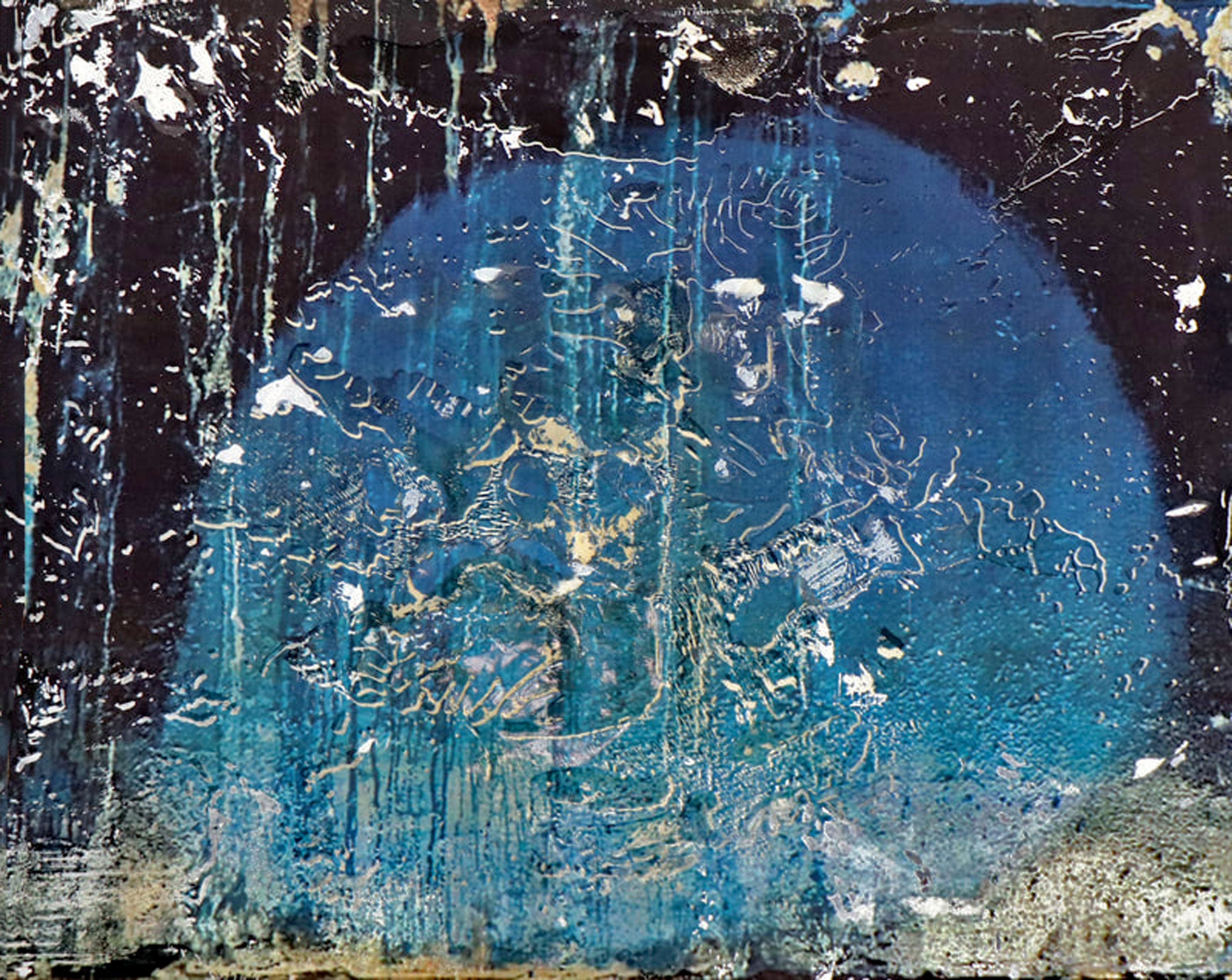
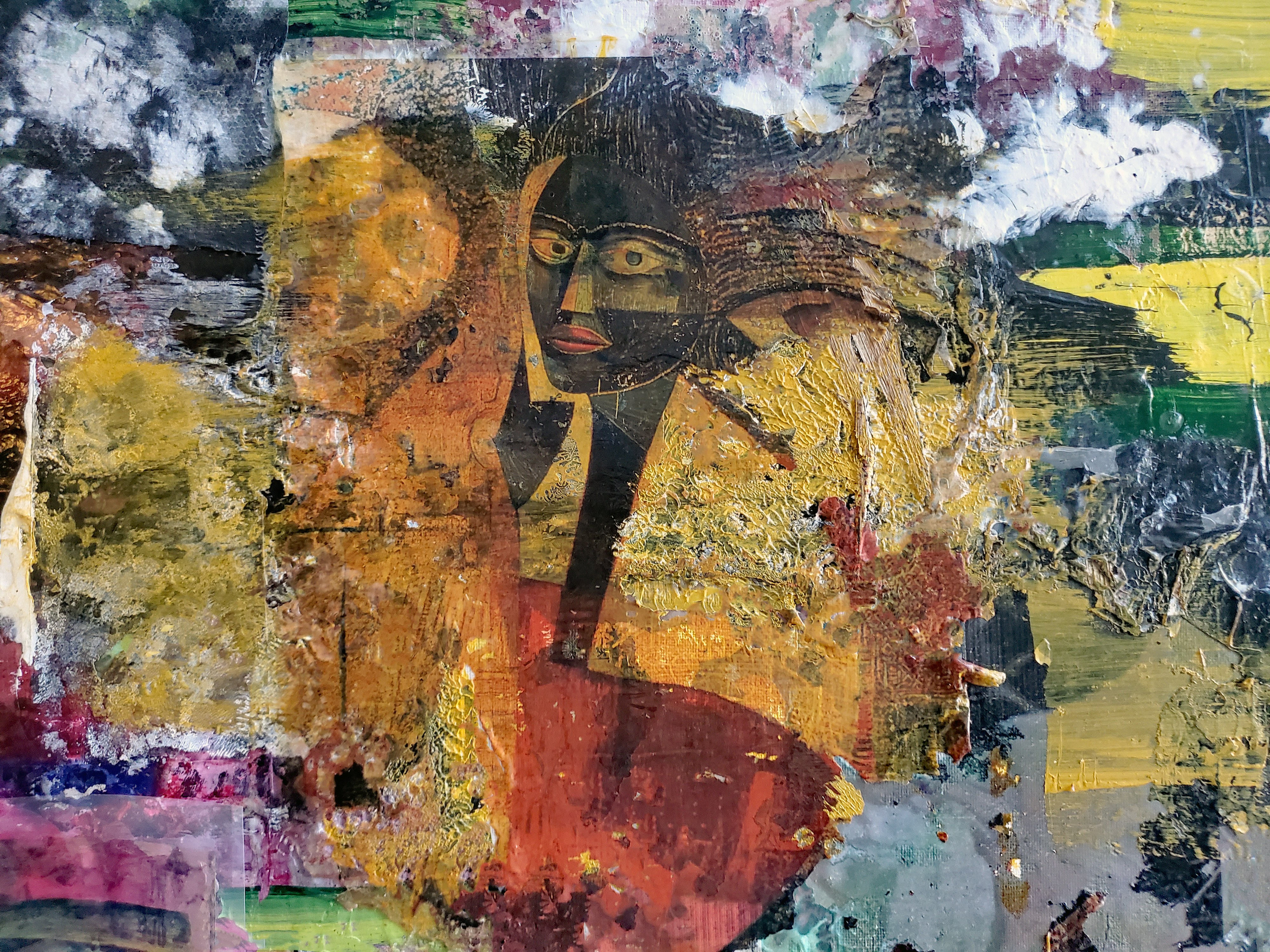
I used to envy dive bar regulars,in their sturdy jeans with softened knees,pointed like sunflowers to the local joint.There were two dive bars on my street,beacons of the block. The same cohortcrawled from one to the other. I guessa cigarette smokes the same East or West.
My friend worked at a bar called McCarron’sand she must have loved it because she neverleft. I visited her once. Mascara, lip gloss,my delicate waist—I pranced into belly laughsand a beer-glazed floor. The jukebox still had 45s,I thought that was cool but the bartenderblared Britney on a Bluetooth speakerand I wanted him to like me.
The red leather bar stools spilled their gutsunder the weight of their patrons. Seethe woman lean into the man, see him smellher hair, see how the wrinkles around hiseyes soften at her tender touch.
I ordered a shot, then three more. I can’tplay pool and I didn’t know the song so I justspilled my guts and punctured dart holesin my hands and feet and went home. My dadnever went to bars. He couldn’t handle his liquorso he drank beer instead and isn’t thatsuch a cliché? He hid his cans in abrown bag, too; quietly became incoherentfrom his living room chair while I solvedMadlib puzzles on the floor. I askedhim for an adjective once and he slurredout Police and I said No, dad, an adjective!
Then a week later he’d have my mittenedhand cupped in his as we walked througha silent snowy night, Christmas lightsreflected off the virgin snow, and he’dlisten to my third-grade woes and takethem seriously, nodding and respondinglike he had something to learn. And whenI leave a bar in December, I wish he wasthere to take my hand and walk me home.I have always been beautiful, you see, butthe kind of beautiful that wasn’t proofread.
I’m still trying to get the hang of Jesus.Dad loves him so much and if he didn’the might’ve gone to bars. He went to Mass,and I have never seen intimacy like betweenmy heavenly father and my dad. I used to envyboth and bang on church doors, soakedin hoppy holy water. The doors crackedlike a sternum but the Holy Spirit musthave been sleeping or somewhere downthe block, because the cavity was empty.So I walked through the snow, carvingvinyl record grooves to fill the silence.
You get what you get:seminaries never answerto chance.
The pool table blooms with quarters—a copse of nickel trees.
To hear the bartender perform numerologywith drink ordersis a kind of neon altar call.
(34 whiskey sours bear wino introspections).
Walking past the closing bars,she describes their futures:embezzlement, a new paint job, and onesecond location.
To hear this, alongside the buzzof closed signs,to feel your tips bulgein your front pocket
is to see the silk road collapseinto a single point.
The great hereafter:
Tomorrow there’ll be people,and they’ll be drinking.
a house won’t build you backthough you patch the cracked backporch each time it splits. the lightwon’t even screw you anymore,though you’re ready to turn the bulbwith a loving hand gloved in tenderness. though you are unafraidof burn marks, ink marks, scratchesthat dye the laundry pink, the laundrywon’t ever soothe your furrowswith the steam and press, won’tfrisk the sink and closet forthe right chemicals—not that one,that one. the dishes sit and reflectyou in their limestone half-moons.doors open and close suddenly,as though haunted, while you sipan eyeball’s weight of whiskey
one at a time. look at yourself.the house won’t build you back.the light won’t even screw you.
Cake has been cruel to my son for most of his short life. At the multicultural festival in second grade, he cried upon learning that the tres leches cake his sister and I were about to eat was not, in the parlance of our family, “OK for him.” At the cookie decorating party in first grade, he was barred from any decorating, even though his food allergies weren’t severe enough to be triggered by touch. And at every birthday party for every elementary school friend, he could never eat the cake. For many years, I would send him with a vegan version of a Hostess Ding Dong made by a local bakery, until he revealed to me that he didn’t like them all that much. Cake is usually served at the end of children’s parties, and by that time, my son’s personal dessert would have been as disheveled and overheated as the guests themselves. I used to imagine him, with his misshapen brown log, watching his friends clamor for a piece of cake adorned with a green balloon, or Pokémon’s head, or their own initial–tiny delights he knew were too dangerous to request for himself.
It’s hard to see this small, morose toddler of my imagination in the face of my seventeen-year-old son. How can this child who lives only in photographs, and ever more faintly in my memory, be the same young man laughing with abandon as he plays board games with his friends? Friends who sport mustaches, some of them even lush, arriving at our home in cars they drove all by themselves? How could that child who used to scream more than sleep have grown into the person who now sleeps through anything, giving the same affirmative answer to my inquiry about how he slept every single morning? The past of his infancy grows ever more difficult to conjure up; his future even more so. In one short year, when he leaves for college, I will spend days, weeks, maybe even months, without knowing what he ate at any given meal, and the most pressing of my questions for him will not be about food. What will it be like for him to study, to laugh with new friends, to write and read and struggle, without me looking on as he does it, without the sustenance of the definitively “OK for him” lunches I still pack for him? What will it be like for me?
When he was a baby, his misery was a terrible mystery. Why did he cry so much; why did he sleep so little? Why was he so uninterested in the music, the foods (especially the foods) that brought me, the woman whose body gave his life, so much joy? Discovering his food allergies just before his first birthday felt like finding the same irrefutable answer to each of these questions, and sometimes, like a pointed condemnation of the first mistake I made as his mother. I’d eaten everything, including plenty of foods he was allergic to, while I was breastfeeding him. I imagined going back in time and consuming no dairy, no eggs, no nuts of any kind since the day of his birth, and thus restoring for both of us the kind of idyllic babyhood I wished he’d had, the kind suggested by the natural parenting magazines shelved near the checkout at the places where I bought our vegan groceries. The mythical babies who lived in the pages of these magazines slept peacefully for long stretches, waking only to babble happily and drink their mothers’ unpoisoned milk. Their smooth cheeks bore no trace of the angry patches of eczema that covered my son’s skin for most of his first year of life; they hardly noticed what was surely the scratchy wool of their hand-knitted beanies. Their benign, smiling faces taunted me as I waited to pay for my soy milk and frozen vegan waffles. For them, the world was like a perfectly temperate bath; for my son, it was more like a deathtrap.
But he was sensitive to much more than just his environmental foes, and his infancy wasn’t all suffering—there was plenty of sweetness, too. The looks I got back from his liquid brown eyes when I read to him, or talked to him (incessantly) about the scenes of neighborhood life we watched from our front porch showed me depths that those cover-model babies could hardly hope to plumb with their placid stares. Once, when he was a baby, swaddled in blankets on my lap, I made him laugh, and I saw his eyes squeeze together in the corners in exactly the way mine do. There! There was something I recognized, a tiny bit of the person I saw in the mirror every day, and thought I knew—better, at least, than I knew this tiny, complicated bundle of sensitivities and strife, my son.
Before he could speak, I was eager enough to let his food allergies speak for him, and explain away all the misery that I felt powerless to understand and dispel. But cake, and plenty of other things, too, still had the power to make him miserable, or happy, or worried, or excited. Once he started talking in earnest, he could tell me about any and all of his reactions to the world around him, whether allergic or emotional. Over this past summer, he encountered the familiar prompt, while preparing his admissions essays for college, about overcoming adversity, and immediately rejected my half-hearted suggestion that he write about his food allergies. We could both see how far this alimentary drama of his childhood had receded behind an array of newer answers about who he was and what made him happy.
When he was little, family members were astonishingly quick to perceive in him those bits of themselves or their children or their parents that they knew and liked best. Surely, his aptitude for math was an intellectual echo of my father–or maybe of his great-uncles on my husband’s side? Of course, he loved the taste of cinnamon, and the particular sweetness of my mother’s apple tart tatin, because she did, too, and naturally, he was skinny because all the men on my mother-in-laws’ side of the family had been skinny. I myself am not immune to the temptation of seeing the best of myself in this beloved child, who might make more of those morsels of me he contains than I ever could. He loves the vagaries of language, and stories, and talking about it all, and when I heard him refer to a “tranche of documents” while talking on the phone to an admissions official at one of the colleges he applied to, I swooned (inwardly) with pride. Who says “tranche” in casual conversation? Not many seventeen year olds, I would guess, but I probably would have been one of them when I was that age.
Yet more delightful by far than the glimpses of myself that I think I catch when I look at him are the many times I’ve witnessed him talking his way out of any such wishful resemblances to me or anyone else; I have relished–am relishing still–getting to know him well enough to realize how far he is from a mere reflection of myself. His college years will separate us even further. He will come home to visit, perhaps in a car he drove all by himself, and maybe I will feel even more stunned by the depth and breadth of his mysteries than I did when he was a baby. I will be reminded of what his immune system has been telling me since he was born: he may be the flesh of your flesh, but he is not known to you fully. When he was a child, we all saw him as though we were looking in a mirror, knowing him only in part, indulging in the fantasy of knowing a beloved person fully. Such is hardly possible for anyone in this life, and yet we strive endlessly, with thousands upon thousands of words shared with each other over the course of our lifetimes.
My son and I have already exchanged countless words, many of which I’ve forgotten and many more that I will soon forget. I’ve written about him a few times–more often when he had no words of his own; less and less often now that he overflows with language. When I think about knowing him fully and completely, I’m terrified–because wouldn’t that be some kind of end? What else would we have to say to each other? My son and I have never been able to eat the same things, but we’ve always been able to talk to each other. I prefer it this way, and I have cake to thank for it, however cruel it might have seemed when my son was a toddler. Here is the difference between knowledge and love, it said sweetly. Have a taste.
My brother Andrew chased rogue commas for a living from his studio flat in Hackney. In the winter, he complained about the cold; in the summer, he was locked in a bitter row with the heat. The autumn was too wet. He sometimes found the spring bearable.
No one ever saw him on a weekday – weekdays were for work. I imagined that he spent the day torturing manuscripts, punishing their authors over missing prepositions, and thoroughly enjoying that business with the em dashes.
Each Saturday morning, we’d meet for coffee at a Nero on the edge of Victoria Park.
“You know, James, the dew point today might break a fifty-year record for January,” he said on one especially muggy occasion, raising his voice against the clatter of North London’s early-morning caffeine rush.
“Yeah, sure,” I replied while checking my phone. Helen had just gone on maternity leave at thirty-five weeks, and we were going back and forth on whether ‘Beth’ or ‘Lizzy’ would be a better diminutive for the baby.
Andrew said something about the coast.
“Yeah, sure,” I said again.
Or maybe it was something about coasting along.
“I’ll be glad to have you over, of course,” Andrew said.
“Huh?” The work WhatsApp group was buzzing over some impending merger.
“I’ve resigned from my position at Perkins and Perkins,” he repeated, “and I’m moving to Great Barnham.”
“Where on earth is that? And when?”
“Tomorrow. It’s on the south coast.”
I had many questions. Chief among them: why?
“Perkins and Perkins offered me a promotion,” he said, as if that explained anything aside from his lack of ambition.
Mum and Dad hadn’t been told: sudden life changes were best announced gradually. Nothing should ever remind them, no matter how slightly, of the time that Andrew had vanished into the New Forest on the eve of his wedding. The search party found him four days later. He was holed up near a brook where we counted tadpoles as children, largely fine if a bit peckish. When his long-suffering fiancée broke up with him that night, he was a picture of equanimity. Our parents, however, never shed their contagious fear of losing him for good. It was then that I started meeting Andrew more regularly.
It was also why, if he hadn’t told our parents that he’d quit his job, I wasn’t about to either. As it turns out, he’d only just broken the news to his landlord. Away from London, he planned to go freelance, which he assured me was less risky than it sounded. It was worth it, he said, to tune out the noise – or tune into the noise, I didn’t catch which.
“You’ll still visit, right?” he asked, now apprised of all my reservations. “It would be a real shame if you didn’t.”
“You’ll have to move farther than that if you want rid of me,” I said, prompting a smile.
The next day, he was off to Great Barnham, a parish near the town of Cramwell and a few miles beyond the coastal hamlets of Yondip and Newton.
⁂
We didn’t see each other for seven weeks. When I finally reached Great Barnham, I was hollowed out by merger madness at work, new-baby nights at home, and tube strikes in the middle.
His thatched-roof cottage was at one end of the village, separated from its neighbours by a farmer’s access track. It still said ‘To Let’. Inside, the dimly-lit interior smelled of dead plants even though none were in sight. Andrew’s coffee was cheap instant granules scalded by twice-boiled water, and mine came in the thinnest of mugs taken from a cardboard box labelled ‘Kitchen’. In his Hackney flat, the only piece of furniture that had been his was a small wooden desk. It was nowhere in sight, so we drank hunched over a badly scratched laminate worktop.
“I’ve joined the parish council,” he announced, blowing across the steam. “They have the most fascinating debates. Did you know that it really matters if the footpath to Newton is called the Barnham-to-Newton way or the Newton-to-Barnham way?”
I shook my head slowly, anticipating one of his digressions.
“The order tells you about the destination: you wouldn’t walk the Newton-to-Barnham way unless Barnham was worth the trouble. You can’t make a mistake about something like that.”
“Are you ever going to unpack?” I asked, stumbling over another box on the way to the empty living room. “Or buy furniture?”
“The thing is,” he continued, “if you were just out for a nice walk, you wouldn’t really care if you ended up in Newton or in Barnham. So I told them that we should call it something else altogether.”
There was another half-hour of this. When we were kids, I’d once locked him in a cupboard for lecturing me on medieval marginalia, and I felt a compulsion to do it again.
“Look, I’ve come a bloody long way to see you,” I said. “Is there anything to do in Barnham, or are we just going to stand in the dark and talk nonsense?”
He gave me one of his quizzical looks. “Grab your coat,” he said.
We climbed up to Newton along the Newton-to-Barnham Way (or Barnham-to-Newton Way). Of course, there was nothing to do in Newton: just the bracing gusts of early spring that buffeted us in places where dormant hedgerows parted to empty fields or lonely houses all rendered in white. We retraced our steps in silence.
In spite of that, I travelled to Great Barnham when the trains were running and Helen could get by without me, which now meant every other Saturday.
⁂
Andrew only lasted a month on the parish council: the naming debate was a one-off and their other activities were not quite so interesting. As a result, he couldn’t show his face at the pub for some time, but he didn’t seem to mind. After all, he said, he hadn’t enlisted for their company.
He bought a sofa. Our conversations were varied and one-sided.
“Do you know the difference between an English semicolon and a Greek upper dot?”
No, I did not.
“Mayflies have been around for three hundred million years. Mayflies! Can you imagine how many mayflies must have been born in three hundred million years?”
And so on. Once, I expressed boredom.
“Get your coat,” he said, standing up with purpose. “I’ve discovered this magnificent thing that you ought to see.”
We walked along the Wherever-to-Wherever Way for a mile or so. There, he found a gap in a hedge, and we passed through thistle and briar, shielding our faces with the sleeves of our coats. On the fallow side of a barley field, we traced a drystone wall, following its bulging meanders into the woods.
The route we cut through the undergrowth was arduous. I was glad for the shade of ancient elms and a brisk spring breeze. Eventually, we reached a small glade furnished with dense mats of bluebells. At its center, there was a ruined stone shell of a building: a former barn or grain store of which only three drystone walls remained. Where the fourth should have been, a scraggy beech rose up, young and askew.
“Isn’t that just magnificent?” he said, beaming.
I was less enthused. “Isn’t trespassing a criminal offence?” I shouted after him.
Rather than answer my question, he planted himself next to the beech and stretched his hands upwards along its narrow trunk, still smiling. I wondered if this sort of scene was why he moved to Barnham in the first place, but there were plenty of ruined buildings about London, and it unsettled me that I didn’t understand his satisfaction.
⁂
In the months that followed, Andrew became his own barber. He received food deliveries at home and sold his car. The bike he bought to replace it remained chained to the same post, rusting. Scattered cardboard boxes were still his cupboards; even his walking shoes were kept in one by the front door.
Our conversations became increasingly mine. Andrew listened, gazing out the window, much like I used to do at Nero. I couldn’t help but think that, like me back then, he felt trapped by our commitment to spend our Saturdays together.
“Beth is teething again,” I said. “And Helen’s back at work, now.”
“How is she?”
“Hoping that she’ll still make partner after maternity leave. It’s tough to come back to that kind of career, you know.”
“Sure,” he replied absently. Then he gave me that quizzical look again. “Does she enjoy her work?”
“I suppose,” I answered. “We don’t talk about it much. When she’s a partner, it will be different, anyway.”
“What about you?”
“A job’s a job.”
“Do you get to spend enough time with Beth?”
“Never. She’s a different little person every day.”
He smiled at that.
As soon as I ran out of things to say, he’d take me someplace he’d uncovered in the midst of an errant ramble: most recently, the rusty carcass of an old school bus whose front grille had become a grassy, lilac patchwork of spring squills. Running his fingers over the drooping tepals that covered the top half of the license plate, he said the whole thing was like a kind of crossword puzzle. If it was, there weren’t any clues.
Without a doubt, his favourite discovery remained the ruined barn. Andrew delighted in telling me how, in the late afternoons, the sun shone through its small westerly window and projected a pink oblong onto the trunk of the beech tree. By the full light of day, if you looked hard enough, you could just about see where this had weathered and lightened the bark. It must have taken him a long time to notice that.
I found myself wanting to stretch out my time in Barnham to observe this phenomenon first-hand, which meant swapping my usual midday train for the evening service.
⁂
One Saturday night, as I waited in Cramwell for a connection to London, the departure board updated to a single row that read ‘cancelled’. As I soon discovered, there were no later trains. I’d be forced to overnight in Barnham with my reluctant host.
We ate microwave lasagne on the sofa in silence. His two-seater being far too short, Andrew then helped me assemble a mattress out of old coats and sofa cushions. He retired early, but I saw light filtering from under his bedroom door late into the night.
On this jury-rigged bed, far from the familiar drone of nighttime traffic, I slept only in short stretches. When the sun came up, my back reminded me that I was forty-four, and three unread text messages from Helen reminded me that I was wanted back home. We ate cereal in silence. The only time that Andrew smiled was when my taxi arrived.
The next Saturday, the trains did take me to Great Barnham, but he wasn’t home.
His front door was unlocked. Noticing that he’d left his phone on the kitchen counter, I helped myself to instant coffee and sipped it on the sofa, gazing out at a garden grown wild from the summer heat. Patches of nettles threatened to strangle untended, yellowed shrubs. Even the window had been colonised by a hairy branch of ivy that clung to its mullion. As I studied the underbelly of the ivy leaves, I saw that the smallest had only three lobes while the largest had five. That seemed like the sort of detail that Andrew would be delighted by.
My ears were just getting reacquainted with the stillness of Great Barnham when the honk of a car horn jolted me from this verdant trance. A taxi was here, waiting to return me to Cramwell. If I waited any longer, I’d have to spend the night again – no one wanted that.
Why wasn’t he there? When I finally made it back to our apartment in Camden, Helen guessed that he’d probably forgotten, but I knew him better than that. Andrew didn’t simply forget about commitments – he shed them like a fleece on a summer walk. I could never do that. Had I become a burden? Helen wanted to know what we did together, what we talked about. In the moment, all I could think of were the ivy leaves. She didn’t say anything, but I think she knew us well enough to understand.
⁂
When I returned two Saturdays later, there was still no sign of Andrew. Anticipating this possibility, I’d come equipped with an Ordnance Survey map on which I’d marked the probable location of the ruin with a red cross. The cardboard box where he kept his walking shoes was empty, so I set off with high hopes of finding him.
The midday sun was relentless and heat seemed to vent through every crack in the ground. Each bush concealed its own cloud of gnats and every one of these tiny grey dots seemed thirstier for my sweat than the last.
I had to retrace my steps twice to find the gap in the overgrown hedge. When I finally scraped myself through, regretting the choice of shorts over trousers, I lacerated the sides of my calves on outstretched hawthorns. One of the cuts bled freely. Having nothing to dress it with, I pressed the map onto it like gauze.
Creeping thistles, spear thistles, and yet more nettles filled the margins of the barley field. By the time I’d traversed its far side and fought my way into the woods, my lower legs were a mosaic of red patches, grazes, and abrasions.
Finally, among the gnarled trunks of the oaks and the ashes, the clearing appeared. As I approached the jagged outline of the barn and its slanted young beech, I surveyed the ruin for signs of Andrew. He was not there.
I called out for him as if he were a lost puppy. When that produced no result, I slumped down against the beech and my mind began to jump to all the unpleasant conclusions that I’d tried to repress. Then, it turned to what our parents would say. Had it been three or four weeks since I’d last seen him? Why hadn’t I tried to stop him from moving to Barnham? What else hadn’t I told them?
“James? What are you doing here?” said a familiar voice. In the westerly window of the barn, Andrew’s face appeared.
“You bloody idiot!” I yelled. Now that I knew he was fine, I just wanted to hurl my phone at him. “I thought something had happened to you.”
“Do you even know why you’re here? All you do is complain.”
In truth, I just wanted to sink into his sofa and quietly waste the afternoon away, alone. Maybe that was what he wanted, too.
“Do you know that the youngest ivy leaves on your window only have three lobes?” I asked by way of reply.
“Amazing, aren’t they?” He said and smiled. “It’s like they’re different little people every day.”
Over eggs, he hands me a photofrom when we were children.
I can still hear the whisperof water running past us.
We spent that whole morningon the muddy banks searching
for salamanders. A band of slick,slender bodies the color of curry;
rusted fenders; a patch of pumpkinsready for the fall. They say you needa lot of patience to catch salamanders.
If you go in reckless, they’ll sense it;sliding into stream without hesitation.
You can’t tell the forest was beginningto burn yet in the photo. We’re squatting
by the bank, sun hot on our faces.Each of us has a salamander in hand.
I still remember the taste and textureof ash in air dissolving on my tongue.
I still see flakes coating evergreen coniferslike falling snow. When wildfire spreadsacross a canopy, they call it a crown.
They say salamanders first came from flame.A tale told for centuries when they were seenin firepits rising from rotted logs, unharmed.
I don’t remember being afraid; the forest rangershelping us pack up the truck; that hurried drivedown the canyon backroads for the very last time.
But even now, I can feel the half-flooded stonemy foot slipped on when I flew into the stream.
I feel the phantom sting in my kneeas I caught something coarse in the fall.
I feel the chill of water flooding over me;streaks of red spread out across the current.
When does a memory become a myth?When does a house become a home?
When does a house become a myth?When does a myth become a home?
A book of facts, quite cumbersome in hardback.The same encyclopaedia my grandfather had bought mefell upon by accident forty years later. Not a hometownas much as a half town demolished, like childhoodis never the actual place you grew up in. Encyclopaediashave no reference for that. The nowhere you moved tofrom nowhere, and moved from again and again. Empty
space where I may have been scanning the pages for flatinformation hoping to spot my grandfatherout in the African desert with Montgomery. Of course,the whole exercise was pointless.
The idea I might have recognised him forty yearsyounger as easily as that man posing for a photograph in uniform,the note on the back, that said, Rome 44. All through the matchI remember my mother trying to call him. Later,she told me the thing that kept playing on her mind was the thoughthe was already dead in his chair, (phone ringing out), watching Englandgetting beat by West Germany, or maybe just thinkinghow only last week, his grandson
had asked him if he’d ever killed a man during the war. I had no brainfor encyclopaedic knowledge. Except I thought that was a factI ought to know that would belong to me alone.
Only memory is not a book of facts. Neither a yes nor a no.I don’t remember his exact words. Instead, I keep thinking how noneof us understand what is about to happen. That those bombswill rain like memories again, flesh dripping from a hand burntbeyond recognition. Knowledge he must have knownhe could never pass on, just an old encyclopaediawhich I never really read. Again, I had it in my handsleft empty handed from the shop of charity. A second chanceto learn and yet I left it there and told myself I would returnwith lighter hands. A question that I can’t take back.A fact long dislodged to erase.
People from Malta aren’t known for being tall, but my mother, Jane, is small even by local standards. She is one of seven children. Her stature, chin dimple, and quiet nature set her apart from the five born before her, and the one born after.
She tells me a story about her older brother placing her in a baby buggy and delightedly pushing her down a nearby hill. She can’t tell it without laughing — and neither can my uncle.
At six, her father dies. She can’t remember much about him, but she can easily recall how special she felt when he took her to town without the others. He lives to thirty-nine.
The house they’re living in is over five hundred years old. She will take me there when I am a baby and then it will be my home too. In its kitchen, she makes the sandwiches we will take to the beach. She doesn’t swim, but she hikes her dress up on the sides and the sun catches her legs.
At sixteen, Jane leaves school for work at a local denim factory. She is not sad about this because it is how things are. She has been sewing clothes at home and wants to work in fashion one day.
She tells me about her grandmother waking her up early to help clean, even though her mother wants her to sleep longer. Cleaning remains what my mother does to help.
She will not wake me up early to help clean while I’m growing up.
At nineteen, she leaves the island and goes to the city where three of her brothers live and she works in factories. She will make party supplies, paper rolls, and package cookies.
I am twenty when her mother dies. One day before this, we are walking down the street near our building and my mother thinks she sees her. She cries when it isn’t her, it doesn’t matter that it couldn’t have been.
She meets my father soon after she settles into life in the city. He is from the same island but isn’t like anyone there she knows. He will bring her both joy and pain and he will die before her. He lives to sixty-two. I will love him immeasurably.
After having my sister and me, my mom will continue to work, and she will continue to clean. She will worry about her children, and then she will worry about her grandchildren. She will wish she had named one of us after her grandmother.
One of her brothers dies early. The one that laughs the most. Another dies later. The one that buys me my first bike.
She will show my daughter the pictures she carries in her purse— the ones you get at funerals.
We will visit those who remain and they will greet us at the airport. Jane will hold her siblings like it’s the last time when we leave. While we’re there, her sister will make us sandwiches and we will take them to the beach. Jane will watch me swim with my sister from the shore.
She tells me she would like to visit them one more time.
Jane is seventy-three and is starting to forget. Someone else lives in the old house. I will not sit on its courtyard steps and read again and my mom will not prepare food in its kitchen.
She is quiet and she sews clothes for my daughter’s dolls. She still remembers her parents, my father, and that day on the hill with her brother.
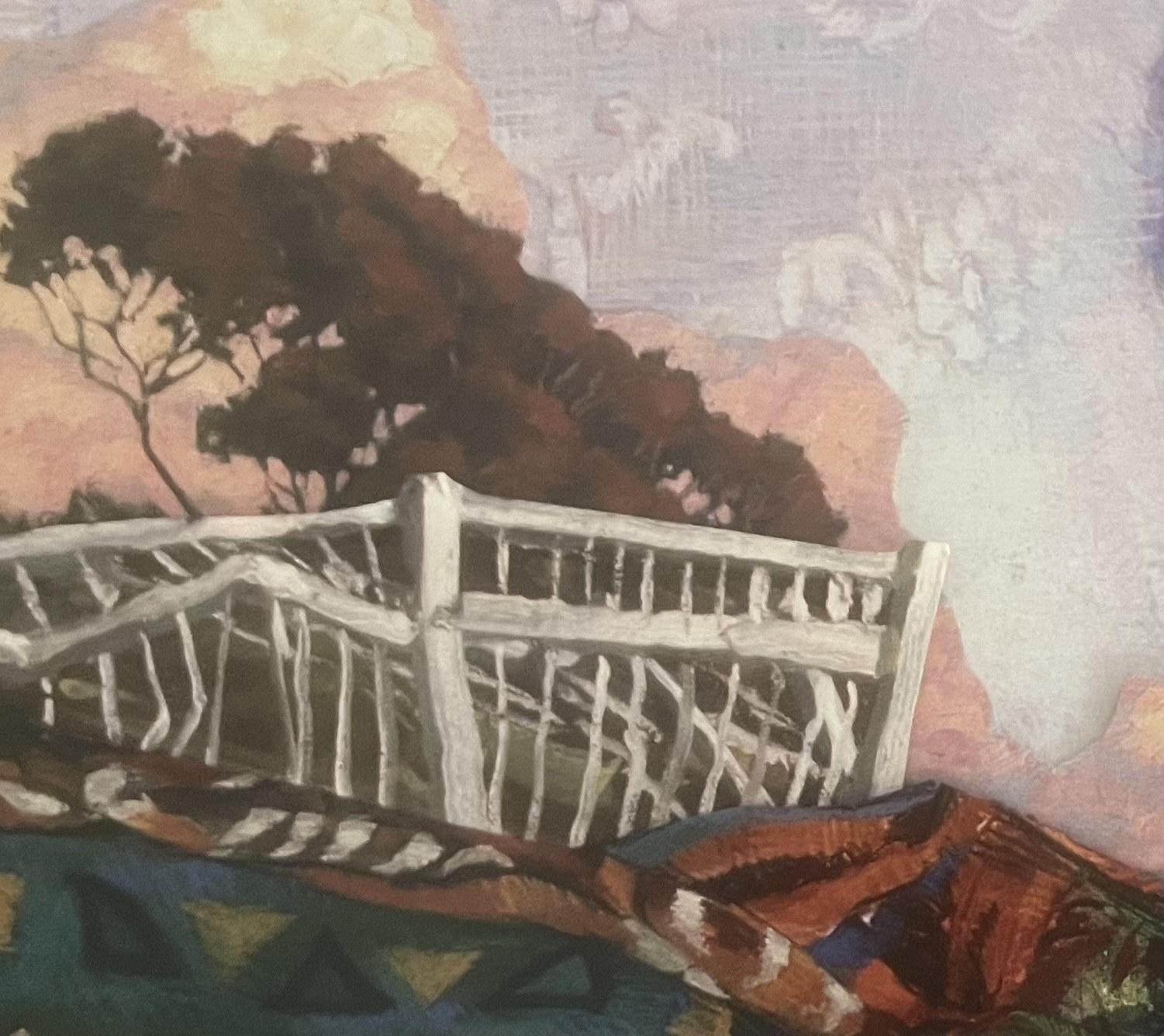
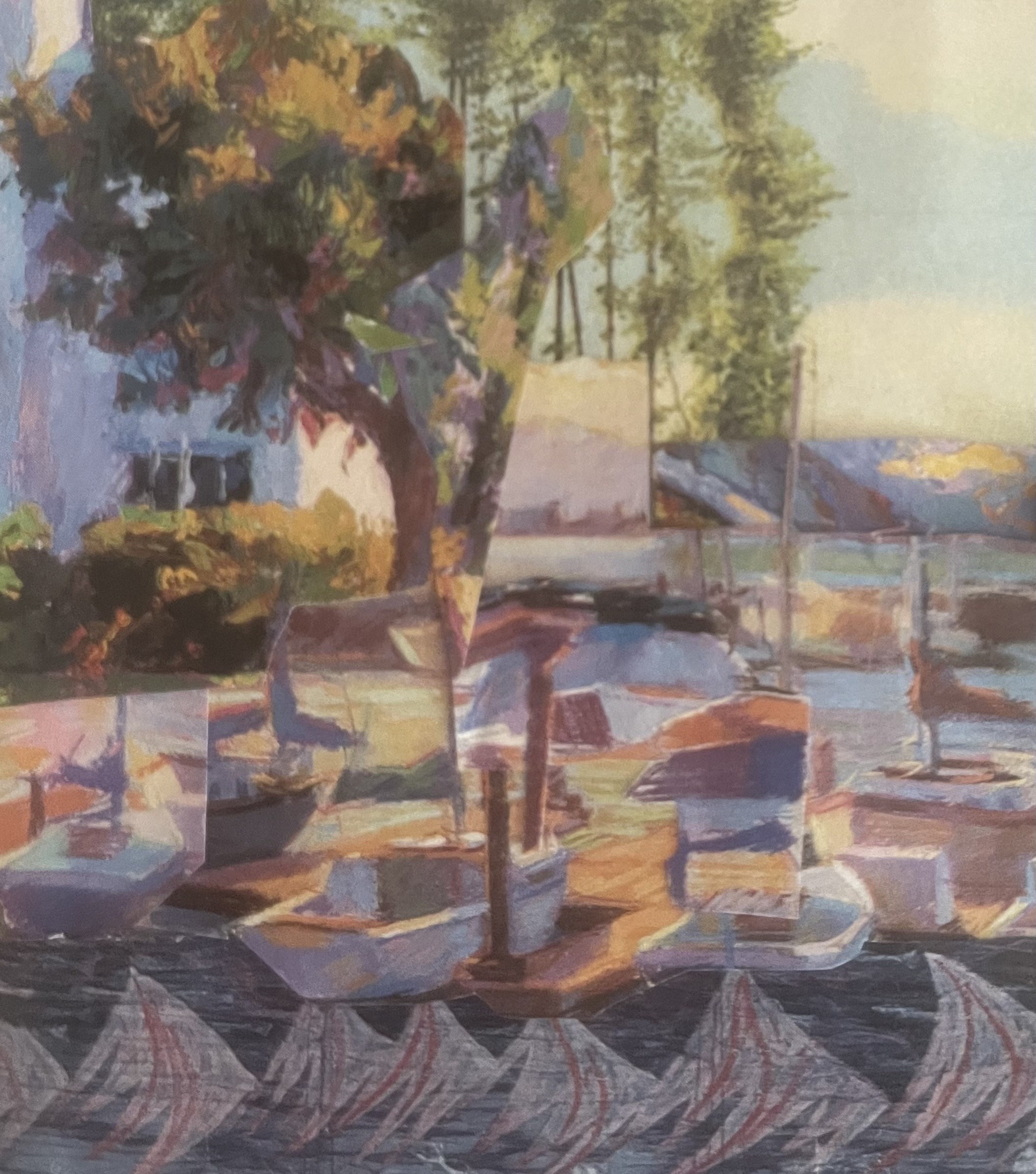
turn down the radio; we think we hear a songas the sirens hit our eyes flashing drop and flareits an art of the jaded and a trap of the tradeone that keeps you thirsty while you forget why you wait
he likes the yesses and nos that structure this gameand the heel-toe dance before we shudderthe tickle of our name on a page or his thumb on our waistscuffed and sliding into the cruiser
it’s fifty-two degrees and we sweat through cheap polyesterthe cement floor sticks to the backs of our thighshis baby bluespinchdialfile
in the morning, he’ll tell me my signature is the prettiest he’s ever seen
I was small and a childand spelling was timed exerciseand we were being tested
And a small like me childWhen the teacher commanded“of”mouthed the wordAndAgainand thenI watched the penas his mind made upon spelling“oV”
and I knew he would be punishederrors are punishedand I hid behindcorrectitudeand wrote:“Of”
And my teacher praised meand the praise became a cavethat I went down inside of miningbright white flecks of pure rightnessand melted cast them to a mask andarmornow well worn so you can see right throughso you know I was meant to write “oV” butclever as preyI mimicked myviolatorand sohid
and when the teachergraded aloud commentedon his error, punishedI laughed soI would becountedamongtheLaughing Right
The Unpunished
the safe from punishment
because I was scared notto point and laugh andI was scaredto be punished too
to be punished meantto be forever notUnpunished
(I thought)
I thoughtI was being testedThoughttheir laughingwould never punishMe
If IwasrightAt hidinguntil I wasNo longer small
I knew from the first night I cried to you,heaving out a harried, ancient fearhow you turned, ashamed for me at the flush of my questionsclanging and fuchsia in the waning light I knewI never even had to gather the courage
That an anydayslong journey to that patch of land would find it fallowand on return, find sympathy with none
That life is a falling, however brief its terror, that will alwaysvise stunning, total, immediate around my shoulders
You could hold me for a hundred years I think, and the secondthe walls of your embrace fell I’d start up again, screaminglike you had never even touched me, a ravaged Troy bent overthe altar of my own profound ache, my wails going velvetinto the hot, crazed fur of the animal I lay with when I lay there
There, where nothing can stand for purchase, or to frictioneven the smallest of limpstick seconds to flame, Therewhere maybe you really are doing everything you canand it’s in me the want is endless, gaping, obscenethe reason I hate the center of myself is the beat of her please!
To fall asleep I imagine plummeting ever downpast everyone I’ve ever loved withouteven a moment to wave (not that I would)even a second to register what expression flashes over their faces(yes, just one for all of them, I decide as I drop)
As I pick up speed with the quick-sketch skids of free-fallthrough a life so thoroughly lethargized by grief, a despair so limpidso indelibly, blackly burnt into the terracotta belt of the urn that standswhere there are no words left,stolid before my son
My son, who may have never even lived a dayslurps a breath straight from Death's beak,a cygnet angelic in his hiccupy greedDo I have time to smile, to watch as he cranes his neck?his eyes go wide, tongue taut and curled like his mother'sto puzzle out what happened here
Why, he can see so clearly, look!here, through the ridged glass! he turns and remarks to no one,that clean through the clay, there, on the other side
Not a door, but see now a window pastwhich so still and softly she will plunge, with only the smallest breathof a kiss for his begging that, but for a corpsen handdragging my curls from under the sash of the nursery pane,you could for a moment believe her the wind
“O” is the circle unbroken, concentric, eternal. The letter “O” does not enclose space, but contains and expands it. In other words, it does not demarcate a quantifiable area, it suggests the infinite. “O” is the wheel ever-turning and the well ever-deepening. It can demarcate a specific area of space only when brought to scale by other elements. The vertical components of letters are like graticules and scaffolding; they measure and build. We can, for example, place a lowercase “l” on either side of “O” to build the letters “b” and “d.” Put all the aforementioned letters together and we can produce “blood.”
The Sefer Yetzirah is the oldest extant Kabbalistic text and the primary source of information on one of Kabbalah’s most distinct and important features: language mysticism. Referring to the twenty-two letters of the Hebrew alphabet, the text explains that God engraved them, carved them, weighed them, permuted them, combined them, and formed with them everything that exists. Kabbalists read this as both a description of God’s linguistic process of creation and an instruction to copy this process in one’s own meditative practices. During such practices, Kabbalists abandon the normal semantic meaning of words and concentrate instead on the shapes, sounds, physical origins, and mental associations of letters, both individually and when combined with other letters. The practitioner must cultivate a state of receptivity in order to receive impressions that could not be acquired intellectually. Only then will he or she be able to discern the true essence underlying language. The 13th-century Rabbi Abraham Abulafia taught that this essence is present throughout all languages of the world.
Notice that “O” opens more when placed inside “blood.” Pronounced outside of this context, the sound of “O” comes from the back of the mouth, but some tension of the lips is necessary. When doubled in the word “blood,” however, the mouth relaxes and “O” flows freely from the inside out. Through the sound of “uh,” the open throat connects to the all without disruption. We give this sound a container when we place it between “b,” “l,” and “d.” We can describe this container as one with a soft, lip-like beginning and a definitive, locking finality.
By “linguistic process of creation,” Kabbalists mean that the world was created with letters. Language is then synonymous with God’s created world, and is the best and most direct way to connect to him. When, during the practices described above, we move from the stage of contemplation of individual letters to that of permutation and combination, we bring the presence of something into being. We must consider all aspects of this created presence, from its individual building blocks to the multi-layered relationships between them. Only then can we discern the essence of whatever we have depicted with the particular letters. Following the logic of a linguistic process of creation, what we are really doing here is discerning the essence of reality, which in its subtlety is normally hidden from us.
What presence have we created through the combination “blood”? A wide open and formless abyss, contained by lines of form – the eternal within time. A microcosmic map of the divine. God, the Kabbalistic Ein Sof, meaning endless, is nestled between “b,” “l,” and “d.” The infinite is nestled between birth, life, and death. According to “blood,” we cannot have only the Holy “O.”
Vowels are our initial impulse, our undifferentiated deep, but consonants and their hard clacking build the world. The traditional Torah is “unpointed,” meaning it was written without any vowels. It is the dry, arrhythmic rattling of consonants. For Kabbalists, this means it is the task of humans to breathe life into the Torah by adding vowels in various combinations, producing a multitude of meanings. Into “FTL” we can breathe “fetal,” into “FTL” we can breathe “fatal.” Vowels here are likened to the animating life force, and consonants to the body which houses it. The body provides physical and linear structure; it provides a beginning and an end. The three Hebrew letters which make up the name YHWH (yod, heh, and vav) are usually consonants, but in unpointed texts they are used to designate vowel sounds. Since these sounds have no beginning nor end, this holiest name of God technically cannot be pronounced.
“O” produces nothing, knows not of death, reaches no conclusions. The combination resulting in “blood” suggests that we need to be contained by form in order to connect with what is formless. We have to climb the scaffolding of consonantal space-time in order to peer into the well beyond it. This combination of letters suggests that we need a body, a body in which blood flows, to carry us towards that which is disembodied.
That YHWH is unpronounceable is no coincidence. Kabbalah has many names for God, but this one encompasses and transcends them all. Each of its letters has a complex meaning, and when combined, they bring all facets of creation together into one. The four letter name unifies past and future, masculine and feminine, human and divine, heaven and earth. YHWH comes from the Hebrew root haya, meaning “to be,” and is thus associated with “I AM,” the name God gives himself in the Book of Exodus when Moses asks what he should be called. “I AM” is the undifferentiated, timeless, and eternal existence of God throughout all creation and beyond it.
This is the subtle and true essence which Kabbalists seek contact with. The goal of the language practices is to recognize and return to the state of pre-Babel unity, where all languages were one. Kabbalistic practice overall can be summarized as a path of return to our original state of oneness with the divine. On this path, to work with language is to see beyond the oppositions we normally hold as indissoluble: between vowels and consonants, feeling and language, I and you, spirit and matter, this thing and that.
To quote the Sefer Yetzirah, “the production of all things from the twenty−two letters is the proof that they are all but parts of one living body” (2:6). All language rises up from the well of unity and thus contains within it the waters of paradise. Could it be, paradoxically, precisely in the diversity of creation, the separateness of bodies, the immense generative potential of words, that we are most able to recognize oneness? I think it could be, and so I believe in the letter “I.”
I believe in “I” because it projects forward into space-time. I believe in “I” because it is my vehicle of belief. I believe in “I” because it quadruples and opens its vertical barricades into deep valleys of “We,” then carries us from vale to vale, out of the womb and into the grave. I believe in “I” because it carries us to the It is and I am.
⁂
Sources
Lancaster, Brian. The Essence of Kabbalah. Arcturus Publishing Limited, 2017.
Westcott, William Wynn, translator. Sepher Yetzirah. 3rd edition, 1887, sacred-texts.com/jud/sephir.htm.
Season 5, Episode 6
A cartoon horse speaks of a free churro,and a grown woman’s stomach dropsto checkered floor.
A kinder kindnessthan ever his mother gave him, he says—and the woman can’t help but relate.Can’t help but taste ironfrom a busted lip long gone,in the space between her tongueand the roof of her mouth,can’t remember if she had cake that day.
A churro.A room filled with strangers.A eulogy for a parent—dead to himlong before her heart stopped.It reminds the woman of home.
Seeing her future in his words—a day will come for her to stand at a wooden podiumand speak of the kindness of strangersbefore ever speaking of family.
The horse is an alcoholic—this too reminds her of home:nights curled in a comfortertight near a space heater’s buzz.Coins do not stretch far enoughfor utilities and drink.
A cartoon horse speaks—a grown woman finds herselfa child again.
By the time I drive past Nora, the sun is casting long shadows from her roadside stand.
She’s where the social media rabbit hole promised: on a two-lane highway through San Ardo’s farmland, sitting behind a card table, smoking and resting her feet on an upturned fruit crate. A few yards on either side of her are handwritten “Good Luck Charms” signs, and across the road is a shoulder to park in.
The dirt kicks up around my feet as I get out of the car and bound toward her. Her sharp eyes circle me like turkey vultures.
“Let me know if you have questions,” she says as I get near.
I offer a smile and scan the top of her table: four-leaf clovers in plastic boxes, three hamsa hands, a herd of crystal elephants, a necklace stand strung with pewter amulets, and a penny. Each item was marked five dollars. I smirk. The gingham tablecloth snaps at my ankles.
I glance up at her hazy, green eyes. “Are you Nora by any chance?”
“Why’re you asking that?” She shifts in her chair.
My hands lift involuntarily. “Oh, no—sorry—I found out about your stand online—”
“I’m not on the internet.”
“You’re sorta famous on TikTok,” I soften the news with a stuttered laugh. “And on Reddit.”
Nora squints, draining her menthol before dropping it onto the cigarette graveyard at her sandaled feet.
“I’ve got no clue what you’re saying to me.”
“Just got a little star-struck, I guess.”
“Why don’t you just get to the part where you tell me what sorta luck you need?” She shoots down my grin with a glare and pats the card table in front of her, unsettling her wares.
“Something I don’t already have.”
Nora points at an evil eye pendant. I reveal the nazar around my neck.
“Rose quartz elephant.”
“Have it, and in tourmaline.”
“Wishbone.”
“At home.”
“Saint Christopher medallion.”
“In the glove compartment—”
“Alright, why are you here? Love, career, health?”
“Just luck in general, I guess.”
“It sounds like you have all the luck you need.”
“Can’t ever have enough, right?”
A car passes us. Nora slips another cigarette into her mouth and lights it. My stomach twists.
“Hon, I don’t have much—I’m sure you’ve already noticed—but I do have time. And you’ve been luxuriating in mine too much for my taste.”
I shake my head. “I’m not here to waste your time—”
“You’re paying me with lollygaggin’ and blabber—”
“I’m a serious buyer—”
“Speak plain,” she says, smacking her foot on the crate. Something rustles in the dead grass beneath it. “Your stories don’t pay my bills.”
“I’ve heard that you help people make their own.”
“You don’t know what you’re talking—”
“I want to make my own luck.”
Nora looks me over, lolling her head to the side. Behind her, a distant murmuration of birds folds into itself.
“You got a hundred on you?”
“I only have a fifty,” I lie.
She nods her chin to my waist pack, and I comply, pulling out a folded fifty and offering it to her. Nora’s hand plucks the bill from mine and tucks it under her bra strap.
From under the card table, Nora pulls out a clipboard with a piece of notepaper struggling against the wind. “Take a picture of this list—yes, you’re gonna need to buy all of it. You can get it at the hardware store in town. You local?”
I shake my head and flatten the paper, struggling to read her handwriting.
“You’ll need a cooler and some ice then too, or it’ll start to smell.”
I frown and look up at her, but she’s already up from her chair and squatting next to the fruit crate. Without taking the tote bag off its spot on her chair, she fishes out a butcher’s cleaver and sets it on the ground.
“Jesus!” I recoil. “What’s that for?”
In a swift, practiced movement, Nora shoves her hands under the fruit crate and lifts a sand-colored rabbit from underneath. She holds it up for me. I only count three paws. The twist in my stomach tightens as she lays the rabbit on the ground.
“Oh, do you have any that are already made?”
My stupidity is palpable under her glare. “How’re you supposed to make your own luck if I make it for you? Hold the cleaver.”
“You want me to cut it off?!”
“Hey, you came to me. This is how it’s done.”
The rabbit heaves in the heat, his fawn-hued fur fluttering in the scattered light, and accepts Nora’s weathered hands on his torso.
Nora sneers. “It’s bad luck if you don’t do it.”
“I don’t think that—”
“Get down here and grab the damn cleaver.”
I kneel in front of the rabbit and, hand shaking, lift the cleaver off the ground. It’s so much lighter than I expected.
“Is he old? Sick?”
“Not particularly.”
I grip the hilt of the cleaver with both hands.
“This’ll get you anything you want. I’m helping you.”
Her voice smells like mint and rot.
“Don’t they scream?” I ask.
“Ain’t his first rodeo, kid.”
The nausea ebbs and flows as I raise and lower the blade over the rabbit’s haunch. His nose wriggles.
“The faster you go, the kinder it is.” She feigns a smile and trails a sun-dried finger over his remaining hind leg. “Just pretend there’s a little dotted line—do-do-do-do-do—right here, and swing.”
I take a sharp inhale and raise the cleaver over my head, searching the rabbit’s face for permission. I see myself in his obsidian eyes.
“I can’t,” I whisper, lowering my arm.
Nora scoffs. “Everyone wants to make their own luck until they know what it really takes.”
I stare at the white toes of my sneakers.
She removes a hand from the rabbit and holds it out for the cleaver. “I knew you weren’t serious.”
Without thinking, my free palm lands in the center of Nora’s chest, sending her onto the flat of her back. Her cigarette flies into the grass beside us.
“Run, rabbit!” I shout. “Run!”
The rabbit looks up at me, too hot and tired to budge. My heart sinks.
“You entitled brat!”
I toss the cleaver into the field behind her and, before she can lunge for either of us, take off with the rabbit tucked in my arms.
“Thief!”
I clutch the rabbit to my chest as I bolt to my car, my feet thudding into the dirt the way his teeth sink into my hand—shallow and thoughtless.
The rabbit bites harder as Nora shouts curses at my back, both of which I tear myself from as I get into the driver’s seat and turn the ignition.
“I’m taking you home,” I say. His nails dig into my thighs as we peel onto the other side of the road.
A truck horn blares as it drives past us, but we’re already driving through the dust we kicked up, passing Nora as she runs onto the road, hurling insults and a rock—both of which land on the trunk of my car.
It takes fifteen miles for the dust to clear from the cabin, for the rabbit’s heart rate to even out, and for the bites to start hurting. I wipe the narrow trails of blood on my sleeve and keep driving, looking down at my three-legged rabbit.
My evil eye necklace, broken and buried under his front paw, glints in the summer sun. I unfurl a laugh into the wind.
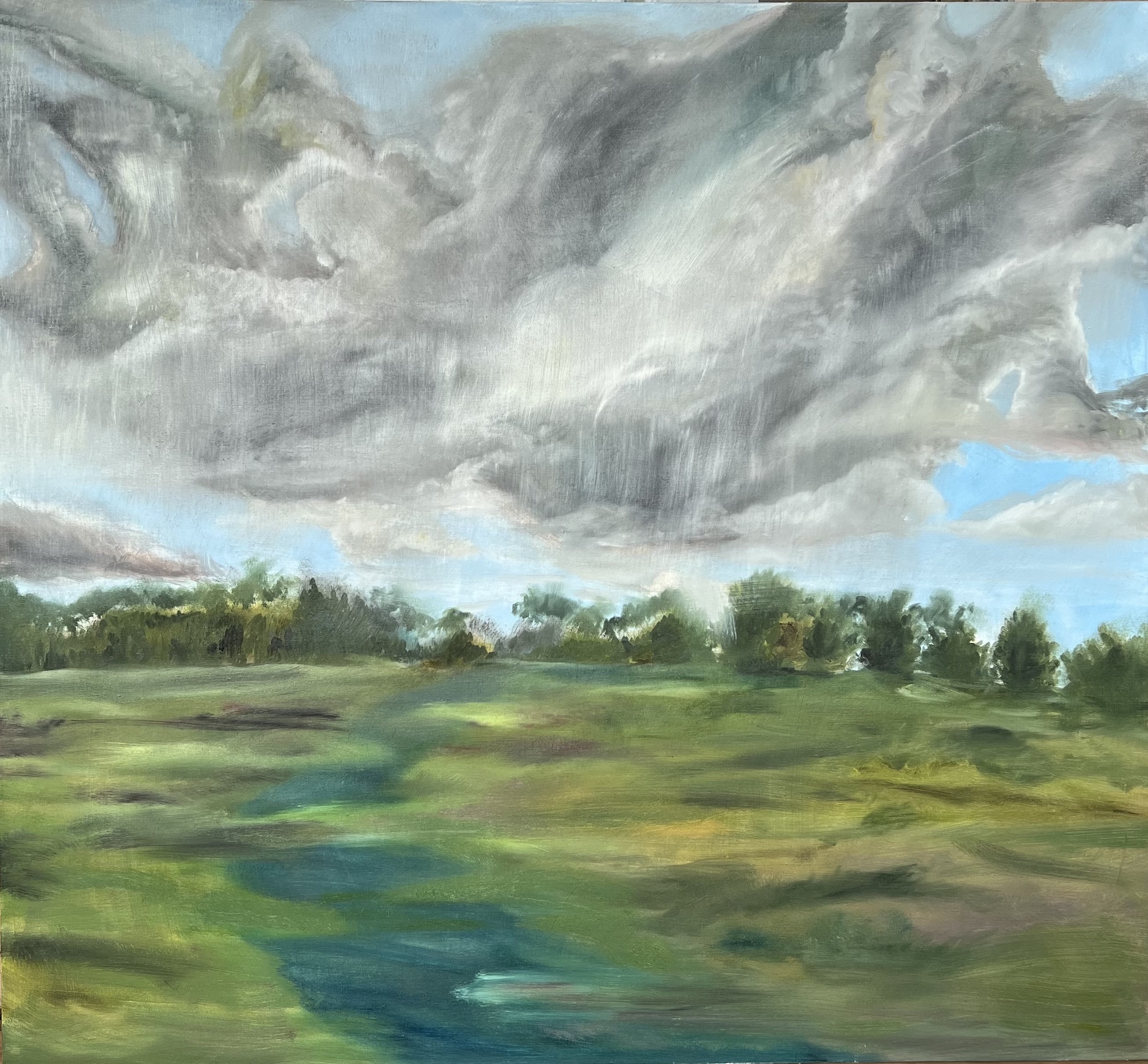
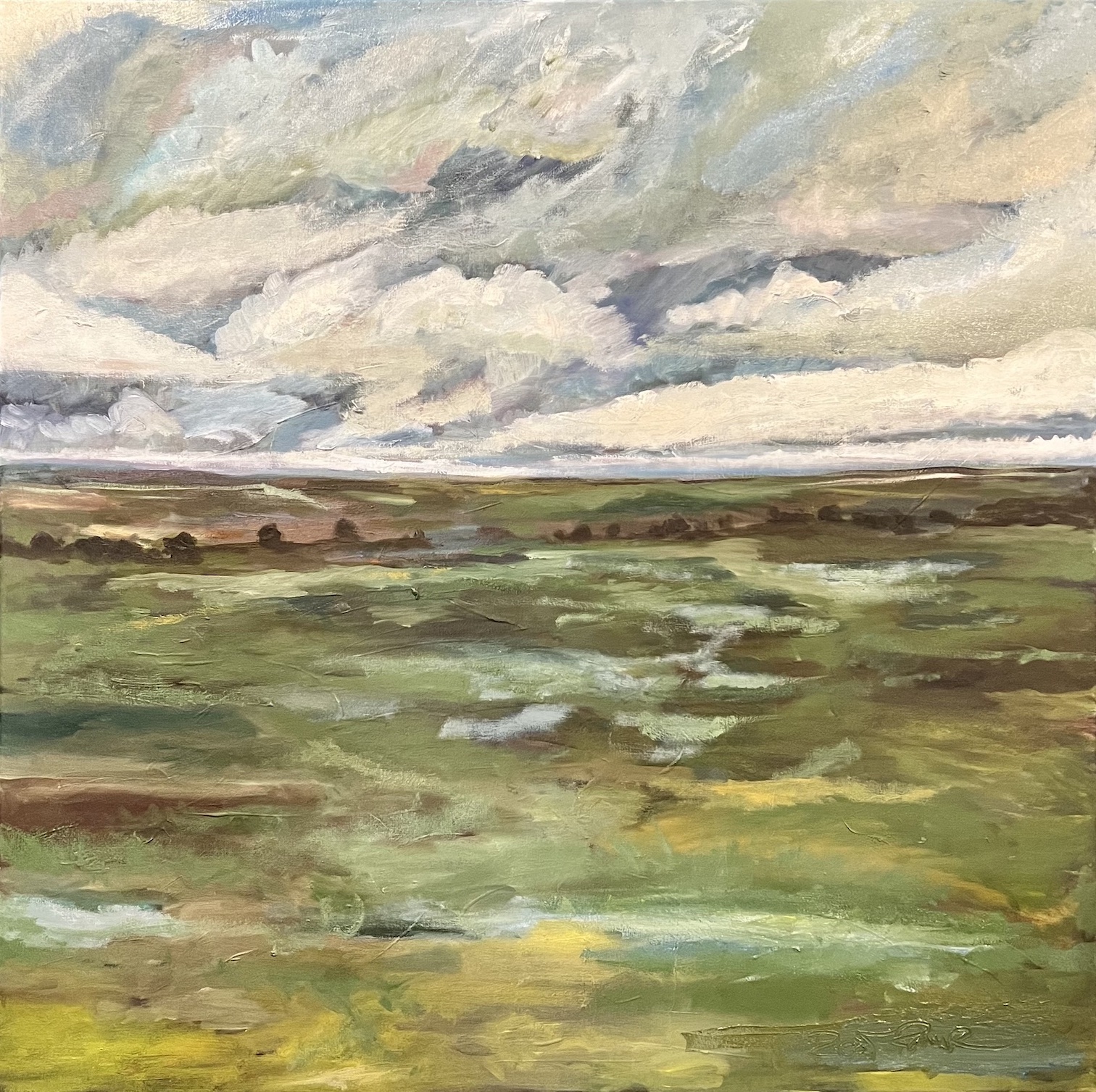
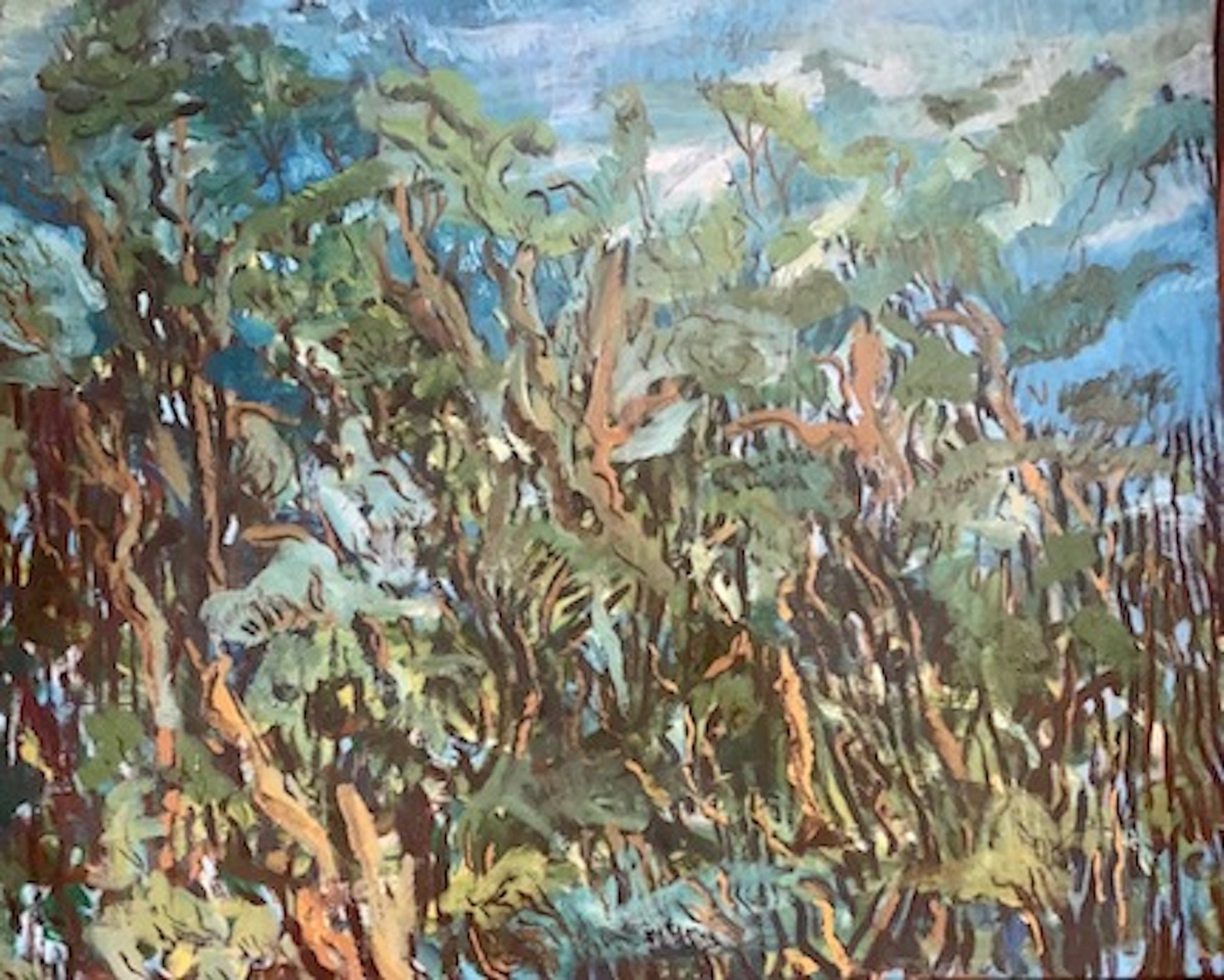
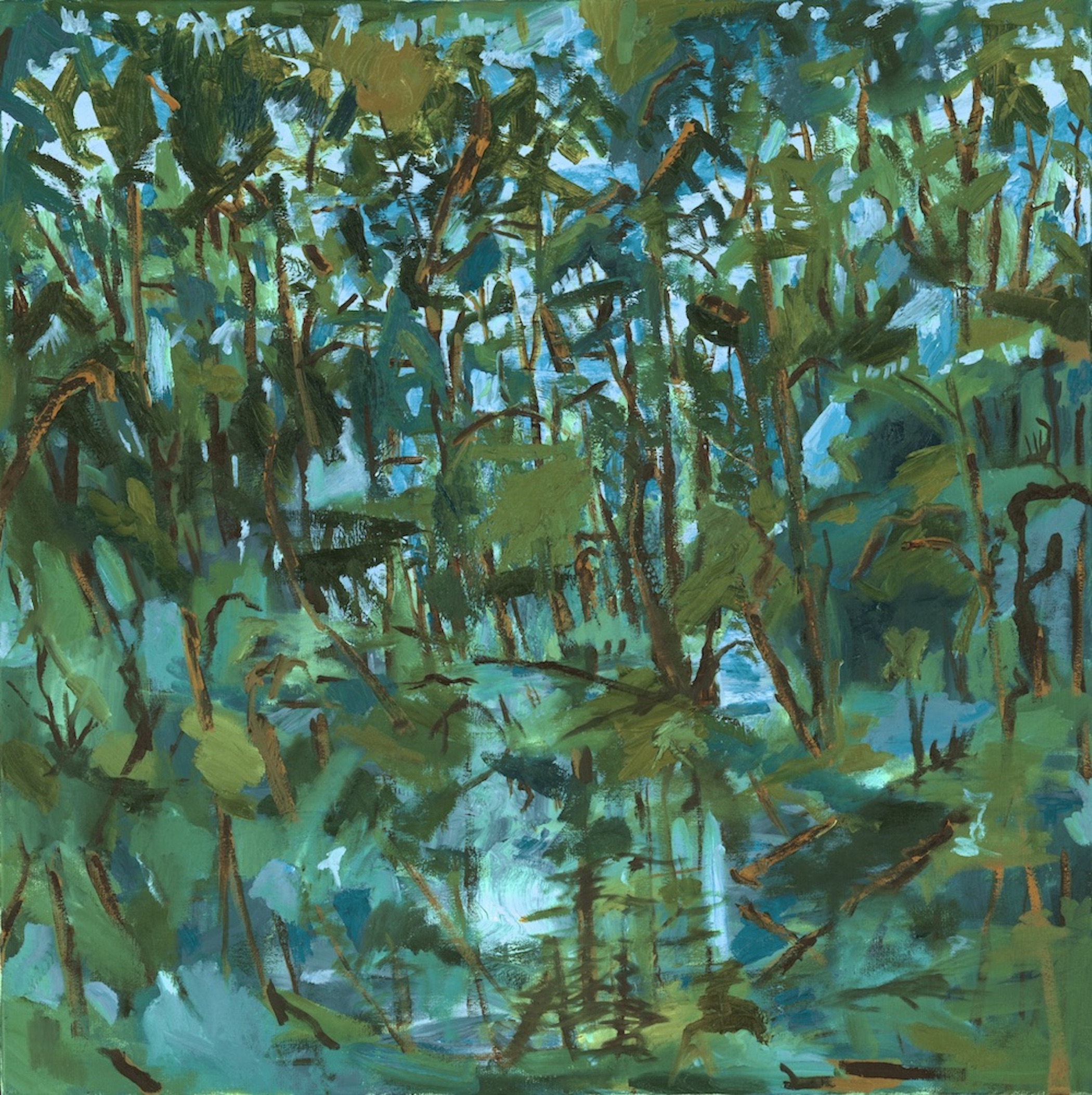
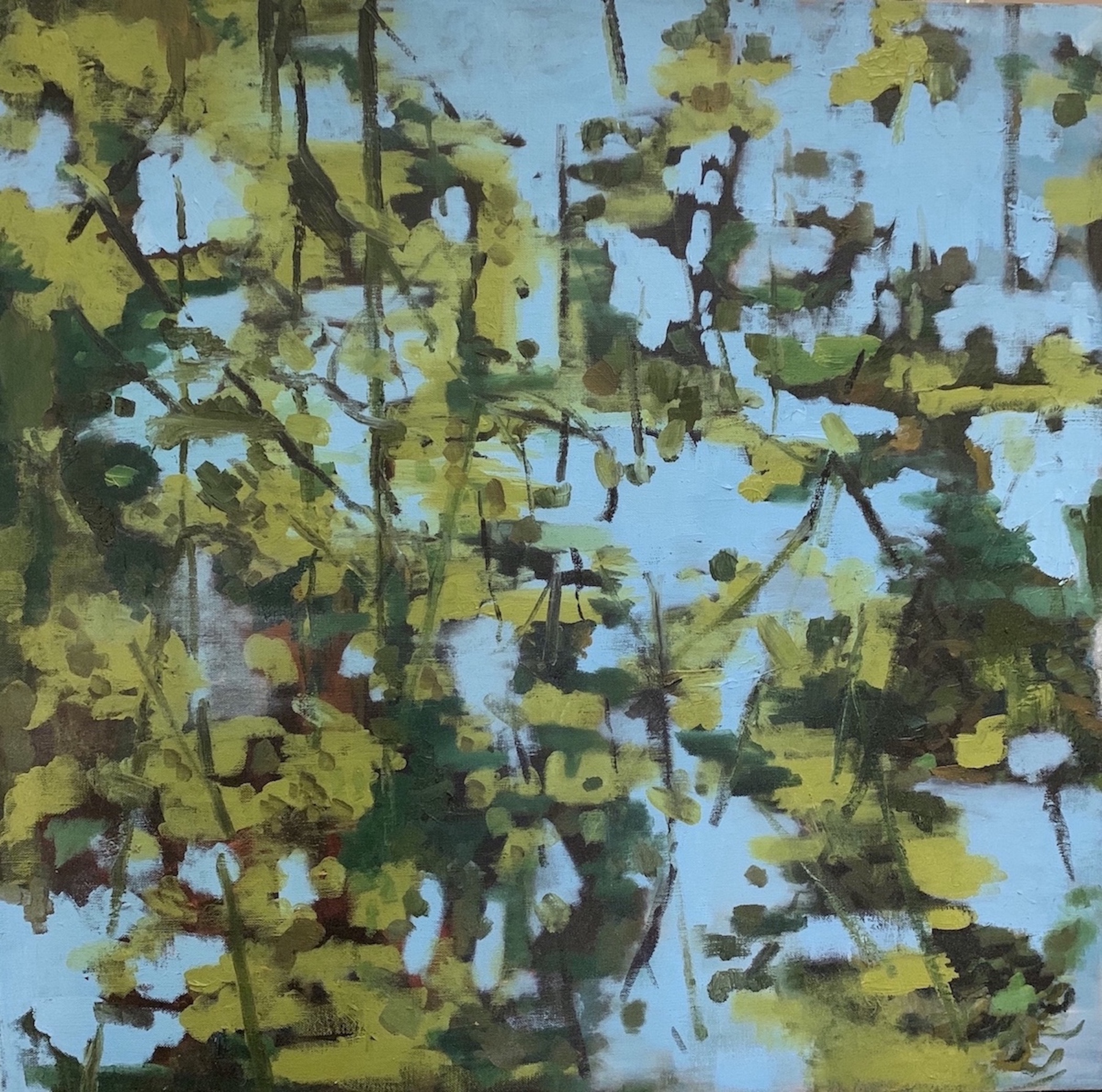
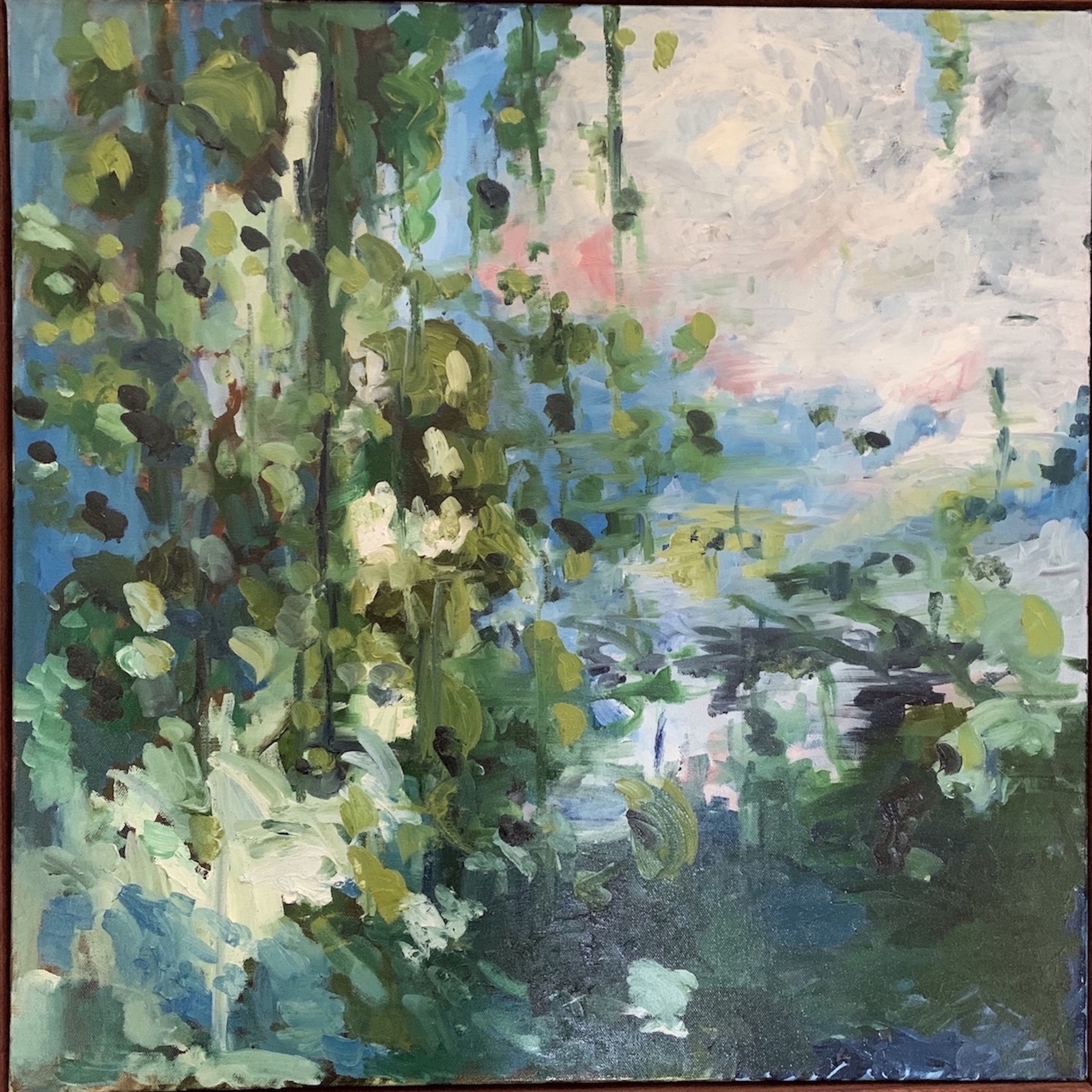
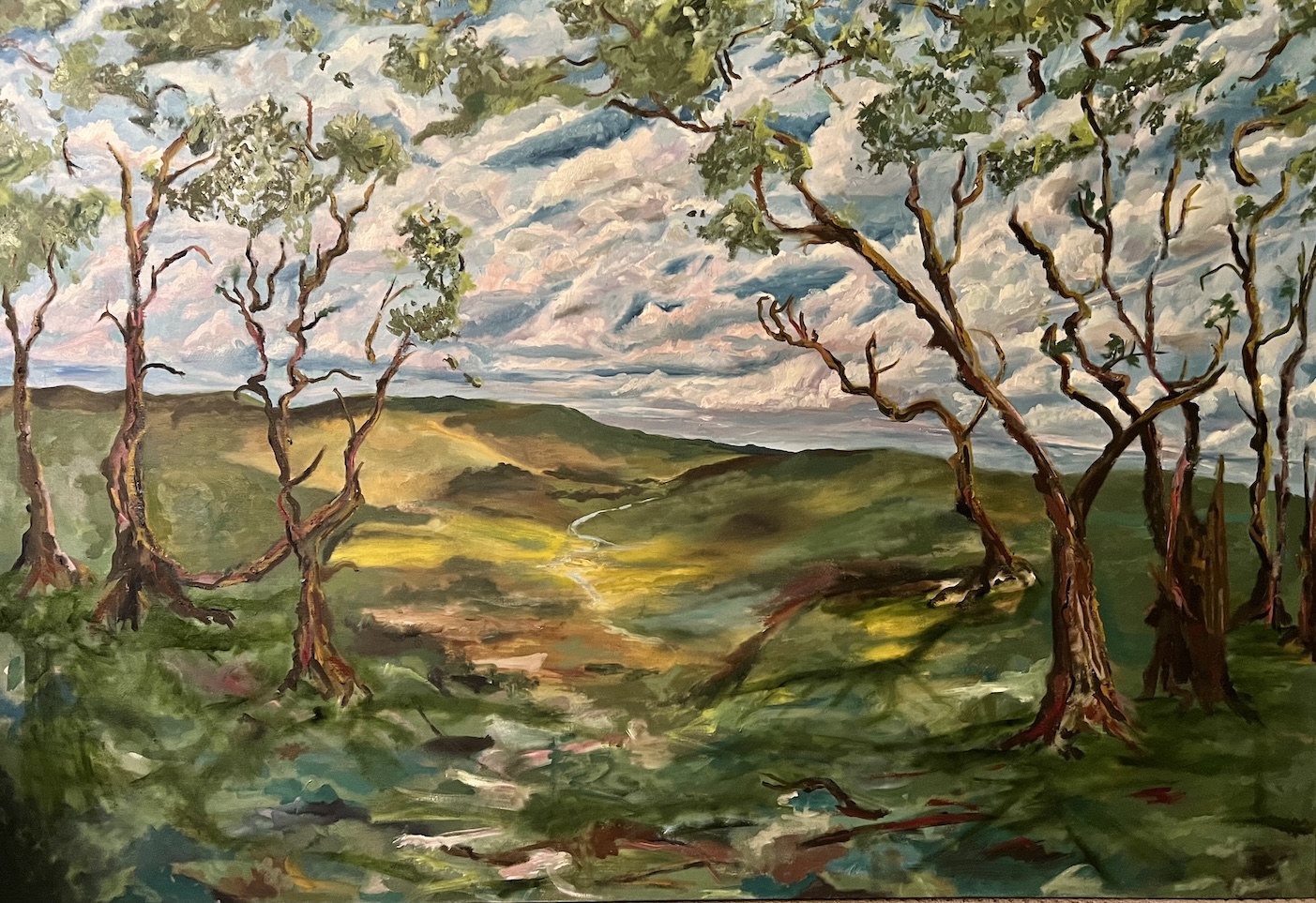
Robert Palmer is a contemporary landscape painter based in Arizona whose work explores the expressive and emotional qualities of the Western environment. Rooted in personal experiences across the Sierra Nevadas, the Puget Sound, the San Juan Islands, the Mogollon Rim, and the Wasatch forests of Utah, his practice blends impressionistic light with a dynamic, expressionistic approach to mark-making. Palmer’s paintings often hover between realism and abstraction, transforming memory and movement into layered, gestural compositions. Palmer earned his BFA in Fine Art from Arizona State University, graduating summa cum laude, with additional training in woodworking and material processes that continues to inform his artistic versatility. His work has been exhibited in numerous local and regional shows, earning awards and recognition for both technical skill and creative vision. He has developed multiple series, including Echoes of Nature and a body of watercolor works exploring light, reflection, and the shifting behavior of water. With a background spanning painting, woodworking, and sculptural concepts, Palmer’s practice reflects a deep engagement with place, memory, and the natural world. His current work investigates the idea of growth—personal, ecological, and artistic—through loose, gestural forms and evolving palettes. He is committed to developing a uniquely expressive approach to landscape while contributing to dialogues around environment, identity, and the role of memory in art-making. Palmer lives and works in Arizona, where he continues to build a studio practice grounded in exploration, experimentation, and connection to the land.
David I. Hughes is a British writer based in West Cornwall. His fiction and poetry has been shortlisted for the Bridport Prize and short stories have received Pushcart Prize and Best of the Net nominations. He won first prizes in the 2026 Streetlight and October Project poetry competitions, and his writing has appeared or is forthcoming in Rattle, The Ana, The South Carolina Review, Sky Island, Superpresent and other international literary journals and anthologies.
Vladka Sokolova is a Bulgarian writer and literary translator based in Varna. She holds an MA in Translation and a BA in English Philology. Her published translations include historical and crime fiction, biography, and autobiography. She previously taught English in Bulgaria and China. Her short story “The Numbers” appeared in The Astorian Journal and won second place in the eighth edition of Bulgaria’s national literary competition “The Tree of Life”.
Morgan Caudill is a poet and teacher from Lexington, Kentucky. Her poems have been published in QuillKeepers Press, Ghost City Press, Wingless Dreamer, In Parentheses and Pegasus. She can be found on Instagram and on Substack under the username @vlntend.
Milo K. Szyszka (he/him) lives in the Mountain West with his husband, snakes, dog, and cat. He loves to collect trinkets and tattoos, learn about fairytales and folklore, and stare longingly into the forest.
Brooke Rajcich grew up in the Pacific Northwest. She writes short fiction and nonfiction.
David Dasharath Kalal is a New York–based artist working across painting, video and digital media. The work follows the afterlives of images, how they drift through memory, migration and history, gathering new meanings as they are carried from one place, culture and moment to another.
Ana Stevenson is a Poet and Short Fiction writer from Saint Paul, Minnesota. She is currently a Master's candidate in Creative Writing and Publishing at the University of St. Thomas, where she previously received Bachelor's degrees in Philosophy and English. Her work has been featured in Written Tales Magazine, Neon & Smoke, Painted Pebble Lit Mag, and Belladonna's Garden.
Gregory Flores was born in San Antonio, Texas, and grew up baling hay and swatting at mosquitos. He is currently a master's student in Penn State's English department where he studies apocalyptic rhetoric and teaches intro level composition. He is a writer interested in exploring the sense of an ending within the mundane. He lives with his dog Frankie in Lemont, Pennsylvania.
Noland Blain (he/they) is a writer and worker in GLAM (galleries, libraries, archives, and museums) originally from Jacksonville, FL. They are currently located in Vancouver, B.C., earning a Master's in Archival Studies. Their writing can also be found in the Penn Review, Black Fox Review, Susurrus, SAPIENS, Funicular Magazine, and elsewhere.
Angie Berkley lives in Ann Arbor, Michigan with her family, where she makes art and zines and teaches writing at the University of Michigan. She maintains a little free zine library and food pantry at her home (@zinesandbeans2026) and archives her work at https://sites.google.com/umich.edu/furbyart.
Michael Bironneau is a writer, technologist and erstwhile mathematician. Though of French origin, he grew up in Asia and the Americas, before moving to the UK where he has lived for the past twenty years. He currently resides in Staffordshire, England, with his wife, Katie.
Nico Dante (he/him) is a poet, essayist, arts educator, and avid traveler born and raised in the San Gabriel Valley. Inspired by place-consciousness, deep ecology, language, alternative culture, and human behavior, Dante has collaborated with poets, musicians, song writers, actors, production designers, and visual artists on multiple creative projects. His poetry, essays, and book reviews have been published in Mojave River Review, Into the Void, TAB: The Journal of Poetry & Poetics, and a variety of other literary journals and anthologies. He holds an MFA in Creative Writing from Chapman University and currently teaches creative writing at the California School of the Arts-San Gabriel Valley.
Jonathan Jones lives and works in Rome where he teaches English and American literature at John Cabot University.
Ramona Galea lives in Toronto, where she works in advertising and pursues her interests in journalism and creative writing. She draws inspiration from the peculiarities of everyday life.
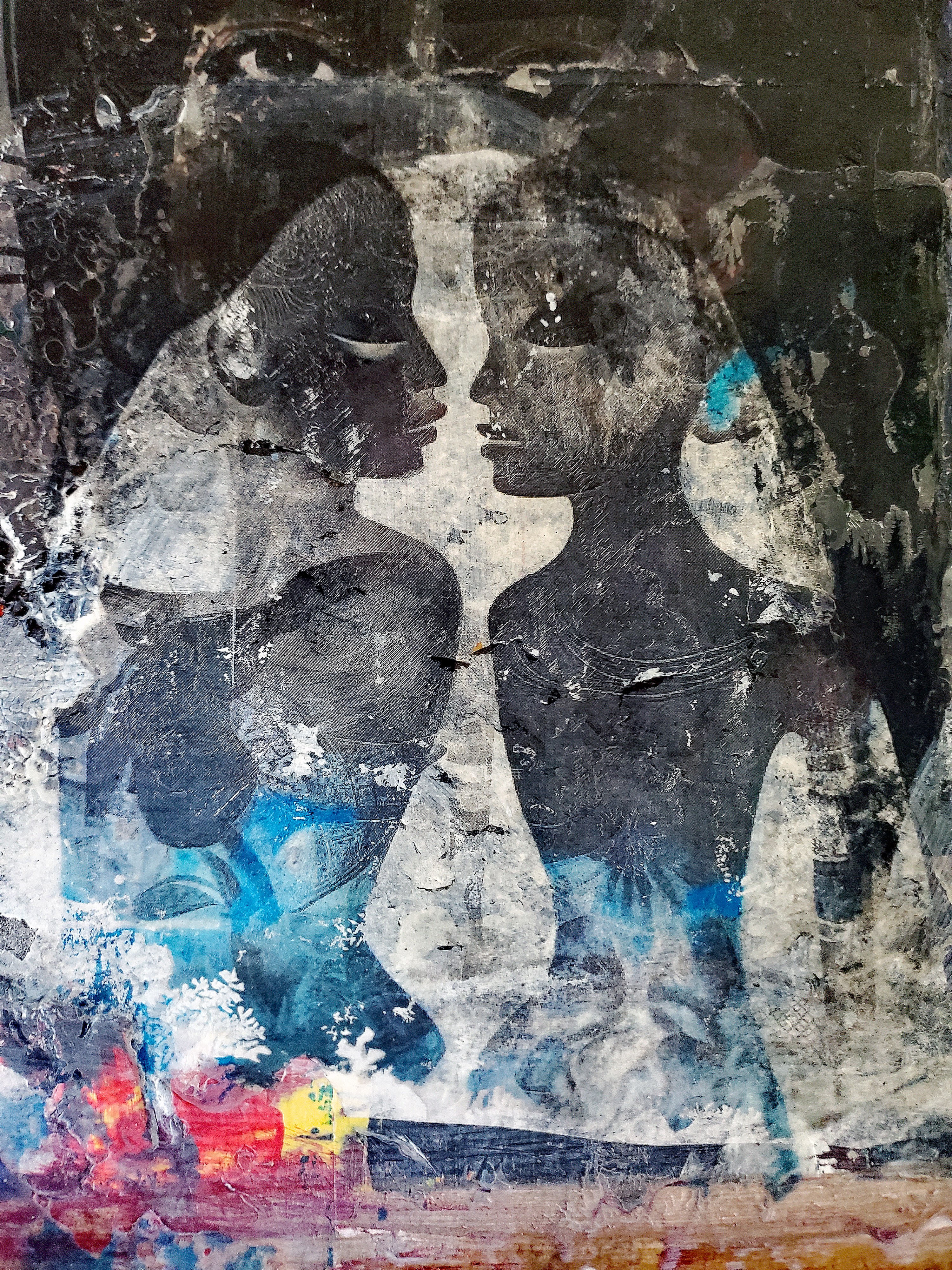
Based in Borrego Springs, California, artist Robin Young currently works in mixed media, focusing mostly on collage and contemporary art-making. Her collage art, using magazine clippings, masking tape, wallpaper, jewelry, feathers, foil, and more, lets her venture deep into the whimsical and intuitive.
Caressa Layne is a writer and artist whose interdisciplinary practice explores the tension between beauty and disgust. Through visual art, literature, and curatorial work, she investigates the unstable boundaries between attraction and aversion, inviting audiences to reconsider what they find worthy of attention. Caressa’s poetry and prose have been published in Art of Nothing Press, The Science Fiction Poetry Association, Plentitudes, and The Dark Poets. She was awarded third place in the 2025 Plentitudes Prizes for Flash Fiction.
Joshua Miguel Noble (they/he) is a Puerto Rican multidisciplinary artist whose work has been featured at the Wallis Annenberg Center, Yale University, the Watermill Center, the National Winter Playwrights Retreat, the Wellstone Center in the Redwoods, the Flea Theatre, the Joan and Edgar Booth Theatre, the Calderwood Pavilion, Hen and Chickens Theatre (UK), the Kadampa Center (Spain), Espacio Kuatro (Spain) and elsewhere, including film and site-specific exhibitions in the U.S., Africa, and Europe. Joshua is the founding producer of Shakespeare in the Shed, Two-Person Book Club, and The American Playbook, and former Artistic Director of the Boston University Summer Theatre Institute. Joshua received an MFA from Yale University.
Emma Catherine Newbery (she/her) is a creative writer, audiovisual producer and poet. She is also the founding editor of ShitHang Magazine, which features poetry and flash fiction from emerging writers. Emma is proud to have written for the Boston Institute for Nonprofit Journalism, Judaism Unbound, Kingston Gallery, The Boston Hassle, Kolture Magazine, and Peachy Den’s inaugural zine Pink Socks. Her debut chapbook, In the Name of the Father, was released in August of 2026. The inaugural issue of ShitHang Magazine will be released in 2027.
Abigail Robejsek is a poet & essayist from Cleveland, Ohio. Her work appears in PopMatters Magazine and is forthcoming in print in the Cleveland Review of Books. She is Co-Editor-in-Chief of Hungercandle Magazine, an online magazine of writing and visual art.
Mecca Miles is a Black, queer writer and spoken word poet from San Antonio, Texas. Her work has appeared in such publications as Torch Literary Magazine, Wellspringwords Literary Anthology, The San Antonio Review, Texas Bards Anthology, When the River Speaks, Voices de la Luna, Voices Along the River, and has been featured on Button Poetry. She has competed nationwide, taking 8th in Florida at the Exit 36 Slam in 2023, and 8th in Dallas, TX at the Right to Write Slam in 2024. She has featured at a number of local venues and was the 2024/2025 Poetry Grand Slam Champion of San Antonio, TX.
Jordan Nishkian is an Armenian-Portuguese writer based in California. Her prose and poetry explore themes of duality and have been featured in national and international publications. She is a winner of the Rollick Magazine Fiction Prize, and a nominee for the Pushcart Prize, Best American Short Stories, and Best of the Net.