

A new study led by scientists from the University of Liverpool analyzed the “memory” of the North Atlantic and created a new framework for understanding ocean memory. They discovered that temperature fluctuations persist for a full 10 to 20 years, which is much longer than current models predict. – Darren Orf, “The Ocean Can Remember 20 Years, Study Says”
I am sixty percent water and tired. The ocean holds almost allof earth’s water and never stills. Even in its darkness,the galaxy’s wetter, no less mysterious twin records orbitsand sends objects hurtling through its space. How large andcavernous that aquatic brain must be to remember how
to retain its energy for twenty years. All this rememberingwithout a calendar. All this remembering withouta single sticky note. Memory is a type of holding,an embrace, so I wonder if that’s at play when the watercurves up and over the bodies of the things in that dark,
thrashing womb, pulling humpbacks down again, afraidof forgetting the curves of their bodies, or the barnacleconstellations dotting their hides. See how the pelican glideson his wide carpet wings into the watery produce aisleand plucks a ripe, ink-filled plum-of-a-squid into his beak,
mumbling a pardon me as he grazes the spotted backof a whale shark vacuuming crumbs of creatures intoher stomach’s hungry black hole. Unbeknownst to her,a congregation of crustaceans gathers on the seabed arounda bonfire in her cousin’s sunken, split carcass, the same cousin
who once shared a beer with a pod of dolphins and won $20for kissing a sailor’s dog on her curious wet nose. The octopusesremember that dare, but the dog does not remember, divorcedfrom the ocean, much like me, who fails to remember what Iate for breakfast an hour after I’ve left the table and discarded
the plate in the sink. My memories sometimes leave melike seafoam. I hoard a pirate’s cove of sticky notes, burydoubloons of birthdays and lunch banter, afraid I might forgeta book title or the curve I made by accident when writingthe letter s. Is it any wonder that sailors mistook manatees
for mermaids? I think it’s the forgetting that scares me morethan the not-remembering, time eating through the ship’s hull,seawater wetting my feet, and I have to patch the leakbefore I’m swallowed. The work is hard. I get disappointedin myself and turn to distraction, decorating my nightstand
with conchs and coral, tying discarded feathersaround my neck. I take a picture of a green seagulland commit it to memory because the oceanwill wash away the paint, and no one will believe me,not even myself.
If I don’t get called up to the counter by 7:00, I won’t get a ticket today. That’s just how it is. Then I’ll have to walk the mile to Scooter’s Liquor because they open the earliest. Jorge will be unlocking the accordion gate that protects the glass door at night. I’ll start counting out change and hope he’ll spot me enough for a pint. Lately, he tries to lure me to the back of the store to get him off in exchange for vodka. I’ve been letting him think I’m game until he slides the bottle across the counter on its back. Then I lie: “I’ll come back a little later,” and walk down the alley behind the turn-of-the-century apartment building where I last lived. Aware that sooner or later I won’t be allowed to just walk away, I down half the bottle.
A man of about 70 is called up, given a ticket, and ambles out to a waiting van. A ticket means eight hours of labor. In vast concrete spaces, for minimum wage, you bend and twist your body over and over until everything hurts. Real employees—if they acknowledge you at all—holler commands over the grind of machinery. If I do get a ticket, it’ll be nine hours before I can swallow alcohol. They cash our checks right across the street at John’s Liquor. I’ll be in line there with some of the people sitting next to me now. We’ll all be close to giddy.
Six months ago, I’d have side-eyed the toothless pregnant woman in the chair next to me and wondered what she had to be so happy about—loud and laughing with the woman whose left thumb is missing. I used to drive past this place on morning commutes. The READY LABOR sign flickered orange, and I’d wonder about the people inside—their silhouettes like voids against the fluorescent light. Now I laugh with them.
The woman with no teeth and the other with no thumb are called up to the counter. Bob, the round-shouldered manager, says “construction clean-up” and hands them tickets and work gloves. I watch them, still laughing, climb into another van. I envy them for being chosen.
I was escorted, staggering, from my last real job. I’d begun drinking at lunch after having a withdrawal seizure in the break room. A co-worker had to Heimlich me while I convulsed because I had a mouthful of Chipotle when the seizure started. A week or two later, the HR lady steered me out of my cubicle with her hand on the back of my neck. I don’t remember what she said when we got to the exit doors, but she looked me straight in the eyes. She wore wire-rimmed glasses. Her eyes were watery and hazel.
The third day without booze was the riskiest. The shaking would subside, and I’d think I was getting some traction. Then I’d be standing in my sister’s kitchen with a tray of rolls on Thanksgiving, or walking for cigarettes, and the next clear thing would be the back of an ambulance or the mud of an alley with my boots and backpack gone. They came with no warning except occasionally my eyes would start to flit back and forth like they do when we’re dreaming, except they’d be wide open. I might have a second or two to get on the ground, and have no recollection of the seizure itself. I’m glad for that.
Each time someone else is called to the counter my hangover deepens. I try to focus on the People magazine someone left on the bus. The sun begins to rise through the floor-to-ceiling window. My stomach growls and flip-rolls oddly. I think of the 23-week fetus I aborted when I was 15. It had begun to move like that. I push the thought down into the hungry space.
If I get sent out, I’ll ask Bob for a lunch. He’ll hand me a paper sack with a bologna sandwich, an orange, and a Little Debbie. Three dollars for the food will be deducted from the day’s pay, bringing it down to $45 after taxes. That’ll get me a handle of Smirnoff, a pack of cigarettes, and a motel room if I can find someone to split it.
It’s 6:45, and a guy in coveralls is folding and stacking the chairs that have emptied. Vaguely, then, a voice reaches me from the raised counter. Nasally and clipped. British. Maybe every other word rides over on my waiting. “Windows… old Victorian… Vine Street…” The accent flutters around my consciousness while I stare out the window, trying not to think of anything I’m thinking of.
“Pay cash every spring… yes sir, yes indeed.” The word cash snaps my head in the direction of the voice. It’s coming from a man not tall enough to see comfortably over the raised counter. From here, I can see three-quarters of his back and the gold arm of his glasses hooked over his right ear. His hair, I can tell, was once brown and has gone beige with gray. He’s wearing a cardigan and khakis, which disorients me for some reason. I shift slightly, about to jump up. Then the man says to Bob, “I have all the necessary tools.”
At that, something opens inside me. My body leans toward the voice, and I recognize the man at the counter—Dr. Eugene Saxe, my former English literature professor. I forget where I am and almost blurt out, Dr. Saxe, it’s me, but stop myself just in time. I feel my chest flush. A million tiny needles prick my face. I sink back behind the magazine. I can’t approach him like this. Not this me. My hair isn’t long and shiny anymore, my face is ruddy and swollen, I’m sure I stink. My feet stay planted on the scuffed linoleum. Self-loathing rises and settles heavy in my limbs.
Two years ago, I was working on a B.A. in creative writing. He led me to literature I never would have known otherwise, and he championed my writing. At the end of our final class, I lingered as the other students shook his hand and moved on. I wanted to thank Dr. Saxe in earnest. We hugged, and I thanked him for the doors he’d opened for me. “Miss Duran,” he said, making my name sound stately, “you are a shining star. You have all the necessary tools to become unstoppable.”
He’d been a stage actor in his youth—Shakespeare mostly—and he taught with overly articulate speech and exaggerated movements. He wore three-piece suits when other professors wore jeans and T-shirts. Over the semester, we developed a sort of game in which Dr. Saxe would pose questions with feigned innocence about stories like “Hills Like White Elephants” or “Cathedral”. Though he expected them, my blunt, off-color responses made him blush and my classmates laugh. When he took us all to see “The Glass Menagerie”, he beamed at intermission standing there in front of the two-story galleria windows. A bright orange squash blossom was tucked into his lapel, and the million lights of Denver’s skyline shone behind him.
Before I became homeless, I found an operable Underwood at a thrift store and carried the ungodly heavy machine six blocks to that turn-of-the-century apartment building. I thought the magic of it might bring me back, but I hadn’t written anything at all. Hadn’t even gotten paper.
While I try to disappear, Bob glances in my direction and hesitates. He’s weighing whether to send someone like me into this man’s home—likely full of small, valuable things. I stand and walk out before he decides, my face turned down and away.
The tenor of that day’s shame, the taste of it, remains unique—20 years later and 15 years sober. I recently tried to find him. I wanted to tell him this story. I found only that he died several years ago. In the obituary photo he’s about 30, handsome in costume and on stage.
Had I approached him that morning, I think he would have helped me. Maybe just by hiring me to wash his windows. He would have acknowledged the seriousness of my situation—he was a serious man—but he would not have made me feel lesser.
For the longest time, I believed I hid to avoid disappointing him. I know now that facing him would have meant grieving the ecstatic, wide-eyed version of myself he had known. I’d loved her, she was gone, and I wasn’t ready to know it for sure.
So, I walked past the back of Dr. Saxe out into the sunny hustle of Capitol Hill. The taste in my mouth was of vodka backing up from my throat, then of burnt paper, then of the green and white peppermint candies he always kept in a bowl on his desk—Starlights, they’re called.
I dreamt that a giant stork–with noble cotton wings,delivered his hand to me.The beak opened like tongs,to drop the hand into my lap.This un-labored thing, my adoptedappendage, I treasured it as ifit had grown in the garden partof me. I swaddled it in gauze,made a tiny mummy, tied a bonneton top. No one would know the truth.They’d mistake the fingertipsfor small shut eyes, they'd seea thumb-shaped nose. I rockedthe hand to sleep, kissed it,held it by the sharp stuck-outwrist bone like a lollipop.Then, I tied the hand to mewith a linen sling, I worethe hand like a pledge.It left a veil of flouron my heartbeat spot.The flour turned my breaststo bread. I tried to wakethe baby hand by singing.I sang a song about hunger.I whispered, my breasts are madeof bread, Baby Hand, youcan have some.
She tried diligently to enjoy the cruise. Ten days on the Aegean—her first vacation in three years without the bitter flavor of field work. She had booked the trip six months before, and at the time the decision felt vital—life-giving, even. The previous week she had overheard a private conversation between two graduate assistants. They spoke of her fondly, as though she were a favored aunt grown eccentric with age. - She really hasn’t lost a step in terms of criticality. I admire that. - That’s true. Theoretically, though…I mean, I understand the dedication to formalism, I really do. But you have to grow with the field or you risk making yourself a relic. Greece was an obvious choice. Its sun had set thousands of years before, but it persisted, lined with craggy coastlines and pockmarked with rugged mountains, respected in its decline. The trip was a private joke, she told herself, a nod to her own waning prospects.
As it approached, she grew to feel differently. She was not a dusty relic to be cloistered in museum corridors, and neither, she suspected, was Greece. What had been conceived as an elegy began to take the shape of rebirth. She would return to the university taut and golden. In her more elaborate prophecies, there was a young man at her side, also taut and golden, still dripping with seawater. The pallid graduate assistants in their cableknit cardigans would whisper and shake their heads, but she would sail past them in triumph, her loyal Adonis at her heels. When she boarded the ship in Athens, she had visions of yanking the thread of her life from the gnarled, grasping hands of the Fates. The hags would protest, of course, but when she returned from the Aegean to present an exquisite tapestry, they would understand. It was her life-string, after all. Shorter and more thread-bare than it had once been, but still hers.
The cruise was nearing its end, though, and she felt a mild panic blooming in her chest. The long days at sea had been pleasant, the stops at various ports suitably lovely. Each day she would study herself in the mirror in her stateroom, eyes raking over her own form, searching for some small change in the architecture of her body. She told herself that these things take time, that often vast internal shifts leave no physical trace. All she could do was keep trying, unfold herself before the mystery of the Aegean, let it seep through her artifice and paint her life anew. Dutifully, she noted each fragmented pleasure. The sun, high and vibrant, whip-sharp against her scalp. The blue of the rocking sea and the angular look of the waves, like cut gems. The salt air that scraped against her red face. These were beautiful things, really. Bracing and true. She reassured herself continually, then grew impatient with her own reassurances. She did not wear gentleness well.
August would have phrased it differently. Not bluntly, exactly. Even as a little boy, he was intentional and artistic in his reprimands. You aren’t fooling anyone with the Mother Theresa act, Mom. Does your skin crack when you smile?
On the third morning, she sat in the dining hall and peeled oranges methodically. As an indulgence, she let herself remember the way August’s fat fingers used to smell like citrus rinds, sticky and rich. She wished she could remember when he had stopped being small enough for her to hold in her arms. There must have been a final time she lifted him into the air, felt his plump hands grasping at her shoulders. She could not recall. She had spoken to his father last month, and he had told her that August was traveling. Last I heard, he’s backpacking through Morocco or something like that. Listen, you need to stop quoting Anne Sexton on Facebook. It’s concerning, and honestly, it’s embarrassing.
Wandering from the dining hall to the upper deck, she fell in behind a couple, two Brits a bit younger than herself. The man spoke too loudly, and the woman not loudly enough. Both were wearing straw hats, like donkeys in a picture book. She felt a stinging disdain crawl into her throat, but she was not sure where it was directed. The pair were blandly innocuous, and she was merely judgemental. Neither was a crime. August would not be ashamed of such thoughts, she knew. He would claim them proudly, grinning with his teeth and saying the quiet thing aloud. It was a distasteful habit, but one that she envied.
On the upper deck, she imagined herself back at the university, furiously scribbling in red pen, knowing her critiques would be either dismissed as myopic or held to as gospel. Every year it was the same—the critical students lacked structure, the structured students lacked criticality. She wondered how she might have handled August if he had been a student rather than her own son. He would have tested her, she knew. His had always been an electric intellect, crackling like a livewire. She wondered if he would have respected her as a professor, if he would have realized she had something, anything, to teach him. August was older than most of her students now. She had not seen him since Christmas, when he had slung insults at her across the dinner table, the tree in the other room blinking pathetically, illuminating his face twisted with resentment. After he left, she had thrown the gifts she had bought for him in the trash along with the remains of Christmas dinner. She had watched the turkey gravy seep into the knitted cloth of a sweater and felt an ugly tug in her stomach, something like satisfaction. And then she had cried, thick wailing tears that carved red tunnels down her cheeks. But that was December, and this was June, and she was not crying anymore. August had blocked her cell number, and she wondered if that meant she was no longer a mother. No one here knew that she had ever been one. On this ship, she was worn down to the sparest image of herself: a woman in a terry cloth robe, nearing the age that inspired questions about retirement plans.
And yet, her mind would not stop churning, staticky with distraction. Standing by the guardrail, she glared at the sea and thought of titles for articles. A woman next to her was speaking loudly into her cell, describing the monastery on Mykonos, chewing on her words with satisfaction. “Island Hopping: The Poetics and Practice of Affluent Statelessness.” Across the deck, a boy of seven or eight slipped into the pool, his slim, brown body swallowed up by the liquid pale. She watched his shadow beneath the water and waited for him to emerge. “Youth Subsumed: A New Examination of the Monstrous Maternal.”
She was beginning to tire of herself. Her boorish dedication to minutiae. She should have been a playwright, she thought. Playwrights were foppish, experimental only in trivial ways. Brow furrowed against the caustic sun, she decided to think up names for plays. It sounded pleasanter than wallowing in academia, and perhaps it would scratch the same shameful itch, her need to package the visual in the glossy plastic of language. Telemachus Goes No-Contact, she thought. Clever, biting yet anodyne. Crowds of young people would stream into theaters across the world to witness her 21st Century Odyssey. It would be so engrossing that the little spectators would silence their cellphones when prompted and sit together in dark silence. She imagined the unhappy twist of August’s mouth when his friends sang her praises with the expressiveness of youth. They would not know, and he would not say. He would only frown, letting just a trace of acid seep into his retorts. It sounds banal. Derivative. But really, what do you expect from an aging professor? It’s almost funny the way they’re always desperately clutching that last shred of relevance.
He would not say anything too earnestly, would not deride her specifically. All he would do was dismiss her wholly, archetypically, without heat.
She could have been an indulgent mother, she knew. If he had asked for permission to do something, to do anything, she would have struggled to say no. But he never asked. August moved through life like a lion cub, slinking and proud. His smiles were quick, his laughter brash. It wasn’t that he didn’t consider her feelings. He considered them, weighed them unfavorably against his own whims, and discarded them like peach pits. Her emotions were an unfortunate byproduct, an obstacle that prevented him from devouring the world whole. And still, he let the sweet-slick juices of his pleasures drip down his chin garishly, as if taunting her. Nothing you do or say will spoil my appetite. You are inconsequential.
She didn’t want to deny him anything. She just wanted to be lenient on her own terms. All mothers felt that way, she suspected. It was only his wildness that had hardened her, a gradual petrification seeping through soft tissue. She had been replaced.
The idea startled and depressed her. She had taken to the water as though it would purify her. She wanted to be sun-bleached, gauzy. And yet, here she was, raw stone even now. The salt air could render her smooth and featureless, but it could not change what she was. All it could do was erode her. In Athens, at the Acropolis, she had paced the cool corridors of the museum, studying the ancient busts—jagged, noseless faces and empty eyes under heavy lids. That had been a week ago. At the time, she had felt a kinship with the sculptors, those long-dead artisans who had lovingly coaxed humanity out of dead marble. They must have imagined a legacy, she knew, but even their most grandiose hopes would have fallen short. For a mad instant, she had let herself slip into a future where her own work held up to two thousand years of scrutiny.
A week ago she knew such visions were ludicrous; now she saw that they were worse than lies. She had stared at those statues and let her eyes believe that they could uncover what was true and human and lasting, that she and those long-dead artists were engaged in the same furious dance of meaning-making. But she was not like them. She was like the busts themselves—cold and cloistered, a mystery long since solved. Like her, they could not breathe life in, could not line their hearts with downy warmth. Whatever humanity they still held was vestigial. They, like her, were obsolete.
The ship was coming into port. The city of Volos grew before her eyes, monstrous cranes and silver cars layered over stone edifices and ancient foothills. Three thousand years folded into itself. Jason stood on the shore, dwarfed by his trireme, dripping with promise. This was before Medea, that most hated of women, loathed by gods and men. Before the child-death that hung over his old age like a curse. Here was Jason in the time before—big-boned like a man, bright-eyed like a child. Like August, she thought. Like all sons. She looked for Jason’s mother, cunning Alcimede. She was not there. She had never been there.
She had the urge to vault the guardrail, let her body crash into the waves. They could dredge the Aegean in search of her bones. They would find nothing but a churning whirlpool, Charybdis writ small. An empty monstrosity, swallowing down shining sailors as though their pulp could give her human form. And at its center: a peach pit, the vague scent of citrus rinds. The kinds of things that rot.
The Mediterranean heat was sour. She was adrift truly now, and wondered how she had pretended for so long. She closed her eyes against Volos, against Jason, against the Aegean and its cruel blue shine. The blackness was stained with sun. Another brilliance she could not claim, a bright spot beyond her control. These things always seep in, she thought. The gangway had been lowered. The passengers filed off the ship sedately. She was not among them, and could not be.
I suppose I’d better move on and tidy up a bit before that new lass arrives.
Every Wednesday she comes, all decked out in her headscarf and long skirt. I don’t know why they still feel obliged to wear it all being in this country. Only her little face protrudes under it. Always smiling.
A community support worker they are called these days. It would have been a vicar in my day. All the same, she insists I call her by her first name, which is all well and good except I can’t pronounce it. So she wrote it down for me in nice big letters and made me say it a few times, but I kept on stumbling and she kept on saying that’s right Mrs. Smith, you are doing great, which is what they always say no matter how badly you are doing. I imagine it works for some people. But I was never any good with foreign tongues you see, not even at school, so I know she is just doing her job. She tried to call me by my first name, but I said I don’t recall giving permission. It’s never a good idea to get too familiar with staff. Still, we manage a laugh or two most weeks.
Not that I need much help mind you. I keep things in pretty decent order around here. Myself included. Not as spick and span as I once did, obviously not and I’ll be first to admit it, but still respectable. Back in those days, while my Gary was still alive, you could have run a white-gloved finger over my skirting boards, and the top of my mantelpiece and it would come back as white as when you started. As my mother-in-law did when she came to visit from Edinburgh. All high and mighty in her matching outfits. Gary and I hadn’t long been out here, in New Zealand. She must have thought we were living in a mud hut. Bringing her good china and good towels with her. Gary and I had a right laugh about it after she’d gone to bed. She’d stayed for the whole month, and by the time we were driving her back to the airport, she said I was as good a housekeeper as she was in her day and may God bless us and keep us both in this place we chose to settle. She left me her good china too. All the same I knew what she was saying – time to start a family.
Well, it didn’t work out in the end, did it. We kept on hoping, for years we did. Gary and I. He kept a brave face on too. Sometimes these things take time, he’d say when he found me crying behind our milking shed or in the bathroom. We’re both still young, love - young and healthy, and working hard, just look around you, how far have we come, there is a plenty of time still, farm is doing great, better than ever as a matter of fact. I knew he was trying to cheer me up, but I could see his eyes didn’t back him up. All the same he would scoop me up and carry me to our bed and soon I would be laughing at his jokes, he was a great joker, my Gary was.
They used to wait for him to turn up down at the hall just to hear him spin a yarn. In winter especially. Pints of beer lining up in front of him. Fire crackling in the hearth. While old Dermot was still alive he’d pull out his fiddle every now and then and soon everyone was merry, cheeks flushed, feet pounding the wooden floor, my Gary swinging me around like we were still courting, back home. All the neighbours’ wives laughing at his jokes like they haven’t heard a joke in their lives before, throwing their heads all the way back, or doubling over, hands over the stomach apparently cracking with laughter, bosoms spilling out. I could see it all. Most of their men couldn’t string a proper sentence, let alone spin a yarn or have a dance. They’d huddle together in the corner, leaning on the counter in their Swanndris and oilskins and red-band gumboots, drawing pint after pint in silence. I felt sorry for the wives.
This is why I didn’t want to let on about anything. Even when the rumours started spreading. That my Gary is helping Beth with far more than just odd jobs here and there. Good old Liz couldn’t stop herself telling me I’d keep my eye out for young widows out there if I was you, in the middle of a shop, all of them giggling into their hands. What Peter says about Paul says more about Peter than Paul, I said. That shut Liz up. Like I’d give her the satisfaction. Or any of them for that matter. When I came home, I told my Gary about it. He acted all surprised. Like he’d ever heard such a thing. He even made it look like the tattletale angered him. Oh, for goodness’ sake don’t they have anything better to do than spread nasty gossip those silly sheilas! Beth is just a woman on her own with a little kid is all! Isn’t our Christian duty to help?
You could almost believe him. If you don’t know any better. But I did. I’d figured it out long before anyone else. Almost at the funeral. It was a dreadful thing how her fellow died – crushed by a horse. He was big on horses, poor Barry was. He bought them young and reared them carefully hoping one day he’ll strike big, raise a racer, a winner that’ll make him rich. Well, he didn’t did he. The big chestnut mare he brought home from somewhere up in the Waikato only weeks before, cornered him against the wall her hooves crushing his chest until his body slumped down like a broken rag-doll. At least that’s what their farmhand said. He was terrified, he said, frozen by fear. Never seen a beast that vicious. It was like the mare was doing it deliberately, going for Barry.
The farmhand left not long after. Leaving Beth and her little boy on their own. Liam was the little fellow’s name. At first everyone rallied around Beth, anything you need, love, just yell out, we’re all here for you. Yeah, right I thought to myself. Wait a month or two. People forget, you see. They got busy with their lives. I was right too.
By early spring only my Gary was still helping. Taking the little fellow on a tractor with him while working Beth’s fields, bringing him home for lunch. Even to the shop with us when we were doing our groceries in town. What sweets would you like today, he’d say, lifting the boy off the ground, both their faces against the jars’ glass*. I’d like those ones*, the little fellow would chirp, pointing with his chubby finger. Oh, you do, do you, my Gary would exclaim, his eyes dancing with joy. And which ones would your mum like, do you know, he’d ask. Those ones, the chubby finger pointing to the very end of the line where imported bon-bons sat in their frilly wrappings*. Right you are*, my Gary would say and ask the shop girl to fill a packet of each as Liam planted a loud kiss in the middle of his stubble. Oh, you do love me now, don’t you!
I’ve never seen my Gary so happy.
I think it was the bon-bons that did it for me. I never let anything on of course. Let him drop me by our gate, said not to worry about helping me unload the groceries, it isn’t much anyway, just take Liam home, he’s looking tired poor little mite, and no need to hurry back, have a few things to do anyway and he’d better not be under my feet and all. He asked are you sure, love, but that was just for the appearance’s sake. I could see he was itching to get away. Get to Beth. She was pretty, mind you. None of that rough, weather-beaten look you see around here. On the contrary, she was tall and slender, her long hair bouncing off her back when she walked. And how she walked! Like she was gliding ever so slightly above the ground, her flame-red hair glowing. In a certain light you’d swear there was a halo around her head. She reminded me of girls back home. Must have reminded Gary too. As soon as I saw the end of Gary’s truck disappearing, I pushed the groceries inside and jumped on my old pushbike. The back track was still dry enough to pedal on it, I thought, and in any case I’d leave the bike in the bushes and make the last few yards on foot. I wanted to see it with my own eyes.
Sure enough Gary’s truck was in the driveway as I tiptoed up to the kitchen window. A thin, cold dusk was settling over the rhododendron and magnolia bushes. I needn’t have worry about being discovered. They probably wouldn’t have heard me if I knocked on the front door. Even if I hadn’t seen him kissing her neck, I would’ve known. She was standing by the stove stirring something in the white-enamel pot, a glass of wine in the other hand, hair pulled in a high bun, only a few feathery strands brushing the back of her neck. Gary sitting at the table, matching glass of wine by his side, a knife-sharpening belt in his hand using it on some carving knives. Little Liam was playing with the train set we’d given him for his birthday. I felt tears gathering at the back of my throat. I watched as Gary got up, pushed the knives into the block on the side of the countertop, moved behind her and started kissing her neck, pushing the loose hairs aside with his thick fingers, slowly, gently. I could feel bile rising deep inside my gut.
But I didn’t let it get better of me. I swallowed hard, brushed the tears with the back of my hand and left. I’d seen enough. As I pedalled back the mud flecked up onto my legs and the hem of my skirt. I pushed the bike to the back of the shed and went into the shower. By the time Gary came home, I was pretending to be fast asleep. I could smell her perfume when he rolled into bed. Laying in the darkness, listening to Gary’s slow, satiated breathing, a thought formed in my mind. As clear as a church bell.
In the morning I got up early and made Gary his favourite breakfast; black pudding fry-up. Oh, goodness me, what’ve I done to deserve all this, he laughed. Gave me a peck on a cheek too. But I could see a tiny speck of guilt in his eyes. He wasn’t a bad man, my Gary. He came back for tea carrying the little fellow in his arms, both of them muddy to their eyeballs. I had scones cooling on the rack. Cream and strawberry jam ready. Packed some for Liam to take home to his mum, I hope she’ likes them, I said. With all the work I bet she has little time left for baking. You could say that again, Gary responded. I could see he was well pleased. Soon I was a regular at her place, helping with this and that, leaving baking, casseroles, offering to have Liam for a sleep-over. She was a little awkward to start with, could never thank me enough. But she soon got used to it. Even smoking in front of me. I didn’t know she smoked. She offered one to me too, but I nearly choked on it which made her laugh. I could see why my Gary liked her. Her laugh spilled out like marbles. It rolled over two glasses of sweet sherry she placed on the table and filled every corner of the place. One time I was sure she was going to confess, even ask for absolution. She’d gone all mellow with drink and remembering her Barry, and then she started talking about how love, true love, cleanses all sins, and there could never be a sin in love, even if people like to gossip—especially then, their minds are simply too small to contain such a notion, a notion of unselfish love and the more you give away the more there is to give and more people we love and love us the closer to God we are, and on and on she went. I just poured her more sherry and kept quiet. But she stopped herself just in time. That dreamy look went out of her eyes, as if someone suddenly snapped their fingers and woken her up. I was right sorry about it. Imagine me hearing it from her mouth!
Then Liam got whooping cough and had to stay in a hospital, so I offered to drive her back and forth on account of Gary being too busy and our vehicle being in much better nick then her old Ford, all of which was true so nothing to be suspicious about. The hospital was about an hour-and-a-half drive each way, so we’d set out in the morning and come back just before tea. She did love that little boy, bringing him his favourite food and soft toys, even the train set. If he felt poorly she’d play stories for him with her fingers, like a puppet muster. Never cried in front of him. Saved it all for the car, I know he’ll get better, I am sure he will, she sobbed. I know God would never let anything bad happened to him no matter how sinful I might be. Well, love, I thought, God works in mysterious ways. Perhaps you should talk to our priest, go to confession, I suggested. I knew she rarely went to church on account of faith being a private matter. Feeling guilty more like. But she just brushed tears off and changed the subject.
Autumn was turning into winter; frost glistened on the road as I drove. The doctor said Liam was getting better each day and would soon be home. She was as happy as a boy in a sandpit. I suggested we stop at the lookout and celebrate with a glass of sherry in that new place, perched right over the gorge. She liked the idea. We were the only two ladies in the lounge. We sat by the fire and sipped our sherries. She couldn’t stop talking about bringing Liam home and all the things she would do to make his room bright and cheerful. I just listened. After the second glass, she clasped my hands in hers. Oh, Martha, you’re so good to me, you’re such a kind, good woman, her eyes shiny with tears.
I suggested we finish our drinks and take the scenic trail back to the car. The air was as crisp as if newly minted. An early dusk spun swathes of fog over the gorge. Isn’t it just magnificent? I said, moving closer to the edge where the path had no guardrail. God truly is a magician. It is breathtaking, she said, following. From the corner of my eye, I could see her wobbling on her heels, the seams of her nylons askew.
The next thing I knew was a hand slapping my face, someone calling my name, my head hurting as if hollowed out, both my knees grazed. That’s all I remember. It turned out Beth slipped and tumbled all the way down. Her body bouncing on rocks until the bottom. Apparently I tried to grab her but slipped myself. It was my screaming that alerted the bartender. He found me unconscious. Police and ambulance came, of course. Carted me to the hospital. Gary came. He was ashen. They kept me in the hospital for a couple of days but there were no serious injuries. Mostly shock, the doctor said. Nothing a good rest and a bit of counselling couldn’t help. Gary drove me home. We didn’t utter a word all the way.
Barry’s folk came and took little Liam with them. They put up the farm for sale too. I suggested we buy it, but Gary just gave me a look. He’d moved to a room at the back by then. He tried to go on as usual for a while, but I could tell it wouldn’t last. A year later he had an accident. Lost control at the wheel and swirled into a tree. His blood alcohol was three times over the limit. It didn’t surprise me. There were bottles stashed all over the place.
I sold the farm and moved to town. Closer to everything; the shops, the doctor, what have you. Besides I’d had enough of them all, gossiping. Liz especially. She even put her vicar onto it. He kept on coming, talking in that butter-wouldn’t-melt voice of his about sin and salvation and whatnot. I could tell you a thing or two about sin, vicar, I thought. But of course I said nothing. Just kept on smiling, making tea, buttering scones. He liked the savoury ones best.
The lights have come out on the street. That lass still hasn’t shown up. Them across the road are having tea. No tablecloth of course. Just a big parcel of fish and chips in the middle of a table. Little ones grabbing a handful at the time. They usually have fish and chips on Fridays. Maybe it isn’t Wednesday after all.

Obscenity swims deep. Momentum, verb,adjective in motion becomes repetition amongminor, ugly variation. Animals come with teeth,knowing the score. Grow up queer and growup knowing the grammar cannot holdthe center. Inevitability, something must give.
We, royal and obscene, must live nowthe way sharks do. Breath come motion,action to reaction to the beginning is the end isthe fucking beginning of our lungs (again).Breathe now or die among the sharks. Their teethcompound to my teeth, cursed to breath, to bite, to beas I am. Told—
(smile, girl, you could be so pretty
if you tried).
Breathe now. The queer is the monster is the metaphoreternal. Page to pen to blood, cycling again. Sharks bite to learn,call it exploratory, this curiosity turned amputation. Truth swungas blood among blood, the word in the waterand this bad smile. Said,
(pretty, after all, is respectable is the lesser of all our dead
remember?)
Of course I bit. Sharklike, the story repeats. The storyswings obscene past enamel and blood and a realbeyond the real. Animals and queers and big, bad teethtaken past metaphor. Understanding written from pressureand hemoglobin. Us to we and back to me again andno respectable center. It came at cost.
Sush now. I cried when they pulled that molar.This goes one way. Nonetheless—
I know something will bleed me and my broken,disrespectful teeth down to the quick.
I know something elsewill survive.
first, i tried pinching:squeezed skin between fingertipsuntil it ashed like i scratchedmy eczema until it spread.i was prideful on how much paini could take as if that meantno one could hurt me asmuch as i hurt myself.but when that wasn’t enough,i tried bitinguntil i felt bone beneath my teethbut never broke skin.what’s a bite or a pinchto a child that got whoopins?who was smacked and slapped
one time one time—my mom popped a blood vessel in my eyeso much so that i wished she was the onewho wanted to die.i knew i needed to find new ways to bleed,so i kept friends that failedto stick up for me.i stuck with mediocritybecause i doubtedanyone else could love me.
and when i did get free,i got freaky:fucked so much i felt nothing.see pleasure can be pain.i tried everything—no fetish pushed me away.i went on a million first dates,begged to be loved,through being a good fuck.i thought partners could seehow i was wifey materialdespite being ripped apart.
then tattered i got tatted.think i prefered the pain paintedi cried after every session.
i never really recover.i yearn to get back under the needle,i’d even pierce my nipples,but i am afraid to lose feelingdespite not wanting to feel anything.don’t that be twisted?
how i hold myself to such a high standard.any mistake i make leaves me crashing,a paperweight,smashing on the floor.i am so good at getting awards,but i never feel like a winner.i once got recognition for beingopen-minded. i accepted everyonebut myself. i once was rewardedin every category at a ceremony,and left with no one to celebrate with andthat hurt more than any cut to the skin.but at least it wasn’t my body that wasdecorated. i have no lines to tell my story,but i love a good read.
sometimes i don’t hide how weird i bejust to feel the pain of people whowould make fun of me, so iguess i got a humiliation kink.
theres a million ways to hurt:i can tell you which one stays,but there’s only a few tosave yourself from the pain.i try something new everyday.i know that even my suicideneeds to be socially acceptable
to a culture that villainizesblack girls—
but why should my death matter anywaywhen the only person i hurt is myself.
I’m reading the obituaries again,scanning a family’s loss, greedyfor the details, the dirtit’s not the gossip I’m after so muchas it is the hows and whys of deathcancer, overdose, suicide?
They say the lucky ones dieof old age as if time is alwaysa gift; sometimes timeis a noose, ever tightening—and the urgeto escape it is a line in the sand.
I’ve never crossed it, though like any boundarythe urge to press up against it rises within me—the overflow of that furious sadnessthreatening to break its container
so, no, I don’t blame them,the ones whose choosing to breakmay be no choice at all
I linger over their condensed storiesand sip my iced latte, the condensationtrailing down the glass, a watermark alreadyforming on the stained wood,
my passing presence containedin the familiar circle that brieflyoverlaps theirs
Bring me the rock of agesThat I may smite mine enemyAnd bury him deep beside sleeping lava,Careful not to stir, further,The quaking earth
Upon his grave, I shall lay the rock that smote himA headstone, baptized with blood
And while his bones smoke with hatredI shall weep for my lost children
And when tears dry in dust and smoke,I make puzzle pieces out of rubble and broken fingers
Then, as if reading to my enemy below,I count the hands and elbows and feetAnd faces and tousled crowns of schoolchildrenAnd grandmothers, of bakers, and nursesOf a doctor’s chest, opened as if by decreeWith a stethoscope buried in his heart
And my enemy sinks deeper into core and magma,Wishing, for the first time in his life, to be read toBy his mother, the mother of assassins
I shall tell him of a time I would have read to him.I shall remind him of a time I could have fed him.I shall revisit a time that I might have loved him,But he has killed me a thousand times already,And the times that would have, could have, and might have beenNever ever have happened.
The thing slipped from her as she squatted over the toilet— a soft thud against the porcelain. Small enough to fit in her hand, she fished it out of the bowl. Her hands sifting through the blood and urine. No bigger than a large grape, slick-skinned and unfinished.
To her, it looked fully formed. Little eyes closed. Ears curled sharp against the skull. She couldn’t tell if it was a boy or girl. She didn’t care. The fifth she’d lost. This one almost made it to ten weeks. Almost.
Outside, the R train grumbled low under the building, the vibrations making the mirrored cabinet above the sink shudder, the walls trembling like the loose teeth in her mother-in-law’s bitter mouth.
She couldn’t bear the thought of anyone knowing she’d lost another one. Not again. Least of all his mother. The pious but mean-spirited Hajji Najla had already started whispering things in her son’s ear. Things that grew and took up residence with them. Suffocating their shared space. They showed up in the way he looked at her stomach when he thought she wasn’t watching. In the way his hand lingered too long on the crib they never packed away.
She could still hear Najla’s voice, low and sour, that day in the kitchen: A woman’s body is like soil, Habibti. Some soil is fertile, some soil is barren. You can’t grow flowers in barren land. She said it while slicing a pear with a small, sharp knife, her eyes never leaving Nafeesa’s. That day had been only twenty-four hours since the last miscarriage. The blood hadn’t even stopped yet.
No. Not this time.
She looked at it in her palm. At the closed eyes. At the small unfinished mouth.
Nafeesa brought the baby to her mouth, opened wide, tilted her head back, and forced it down. One hard swallow, her throat burning raw against the push of it. The blood still slick between her fingers. She put her hand to her mouth to make sure she wouldn’t throw up. She sat on the edge of the tub with her eyes closed until the nausea passed.
Tucked inside her. Safe.
The hollow in her belly began to fill up. She pressed her hands there, whispering under her breath: Stay. Stay.
She cleaned the toilet, the floor, the sink, scrubbing until the bleach stung her nostrils, until her knees burned against the tile. By the time she left the bathroom, there was no blood, no stains. Everything was in order.
She brushed her teeth, washed her face, and slipped into a pretty dress. The kind she wore when she wanted to feel good about herself. Long, puffy sleeves, flowing, and butter yellow to highlight her hazel eyes. She applied plum-colored eyeliner to make the green in her eyes stand out.
She balled up the blood-stained underwear and dirty cleaning rags, stuffed them in a plastic bag, and walked out into the dimly lit hallway and over to the garbage chute. She pulled the door open. The smell of garbage filled her nostrils. She pulled down the metal shaft door and threw the evidence into the incinerator.
Stepping back into the hallway just as Marta, the super’s wife and part-time assistant, was coming up the stairs, a little out of breath.
Marta wore gloves, even when she wasn’t elbow-deep in garbage bins. She always separated the trash on Sundays. Monday was pickup. She sang opera while she did it. Said she gave her husband the day off —two jobs and all that — but all the tenants of 72nd Street knew better. She liked to know things. She liked to know people. And she knew enough to burn you down quiet, if she felt like it. She gave Nafeesa a small nod as they passed on the landing. Then, without looking back, said, “Pretty dress,” and kept climbing.
Time to get the day going.
The kitchen was thick with heat, the window sweating against the fraying wooden frame. Okra stew. That’s what Khalid had asked for.
Nafeesa hated the way the okra kept its slime even after you fried it, hated the way it clung to the spoon like spit. She would never eat the stuff. Disgusting, she thought. But she had fried it the night before, the way his mother taught her. Roll it in flour, flash-fry, and drain it from oil. It was still slimy.The okra went into the bubbling pot with cilantro and minced garlic. Tomato sauce hissing as it boiled. The smell rose, clinging to the walls, to her skin. Her stomach twisted. The floor swayed under her feet.
Nafeesa turned toward the hallway, toward the bathroom, but she couldn’t move. She bent over the stove and threw up just a little bit into the steaming pot. Red fluids mixing in with red stew.
And for a moment, for the briefest, most unexpected moment Nafeesa laughed.
A loud, cracked sound, slipping out of her before she could stop it. The food, the blood, the loss, all of it folding into each other like bad magic.
She wiped her mouth with the sleeve of her dress and just stirred a bit of herself and their baby into his food.
Fold it in, she thought. Fold it in like everything else.
The front door creaked open. Khalid came in quiet, as always. Took off his shoes and lined them up inside the closet like he did every day. Slipped on his house shoes. She heard him cross the floor, his steps light.
In the bathroom, she listened to the long sound of his piss hitting the bowl. The same bowl their child had floated in hours before, for just a few minutes. He stepped into the kitchen, sniffed the air once. “Smells divine,” he said.
“Extra garlic,” Nafeesa said, smoothing her dress, steadying her hands as he leaned in and kissed her, soft and quick. “Sit,” she told him. “Sit. I think the okra might actually be good this time.”
He sat at the round table that filled most of their narrow kitchen, same chair as always — the one backed tight to the window. Later, after he ate, he’d turn it sideways, light a cigarette, and stare out at the old green Methodist church pressed up against their building. It had been there long before the apartments were poured around it, holding its ground. He loved that something so old lived next to him. It reminded him of the homes he left in Southern Lebanon. Stones stacked by hand, generations pressed quiet into the mortar.
His face was gentle, but his shoulders sagged with the weight of too much. Nafeesa did love Khalid. She figured he still loved her, too, in his way. But she knew what she was worth in that house, and it wasn’t her cooking, or her kindness, or even her beauty. Which she was. It was in her womb. Her worth lived there now, in what it hadn’t yet done.
She had to give him a child. Their families and friends made sure she understood this is what a marriage needs to survive. A family. Legacy. But it wasn’t just them. She saw it in him, the longing in his eyes. She felt the urgency in their lovemaking. That want pressed on him like the rest. Constant and heavy as stone.
She watched him lining up his fork and spoon, shifting each just slightly until they lay perfect and straight beside the plate. She’d thought she’d set it right, but she never did.
She ladled the stew into bowls. Placed one in front of him. Sat down across from him. He stopped fiddling with the silverware and looked up. “You’re eating okra?” he asked, puzzled. “You okay?”
She didn’t look up. Just brought the spoon to her mouth, slow and steady. Blew on the food to cool it down.
“The baby likes it,” she said. “Must take after his father.” A small pause, “New craving, I guess.”
“Bismillah,” they both said.
She chewed. Swallowed. Swallowed again.
And just as she forced down another mouthful, she felt something in her belly. A flutter.
A beat no heavier than the wings of a moth tapping on a windowpane. She pressed her hand flat against her belly, willing it to stay, to root, to become real. Feeling the small weight inside her — the hidden, desperate thing she had tucked back into herself. Outside, everything and everyone raged. Inside her, for one trembling moment, it was still. It was warm. It was almost enough. Almost.
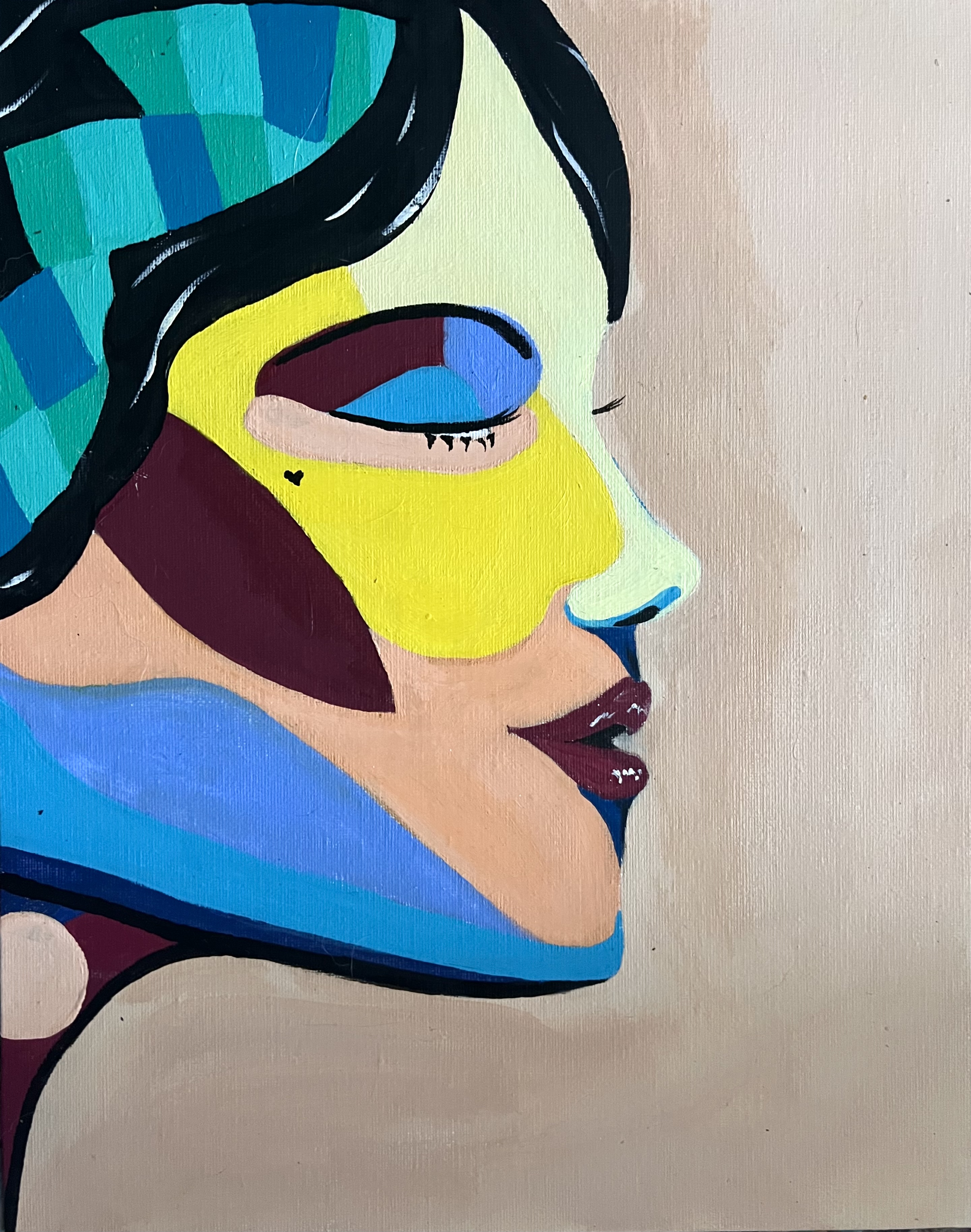
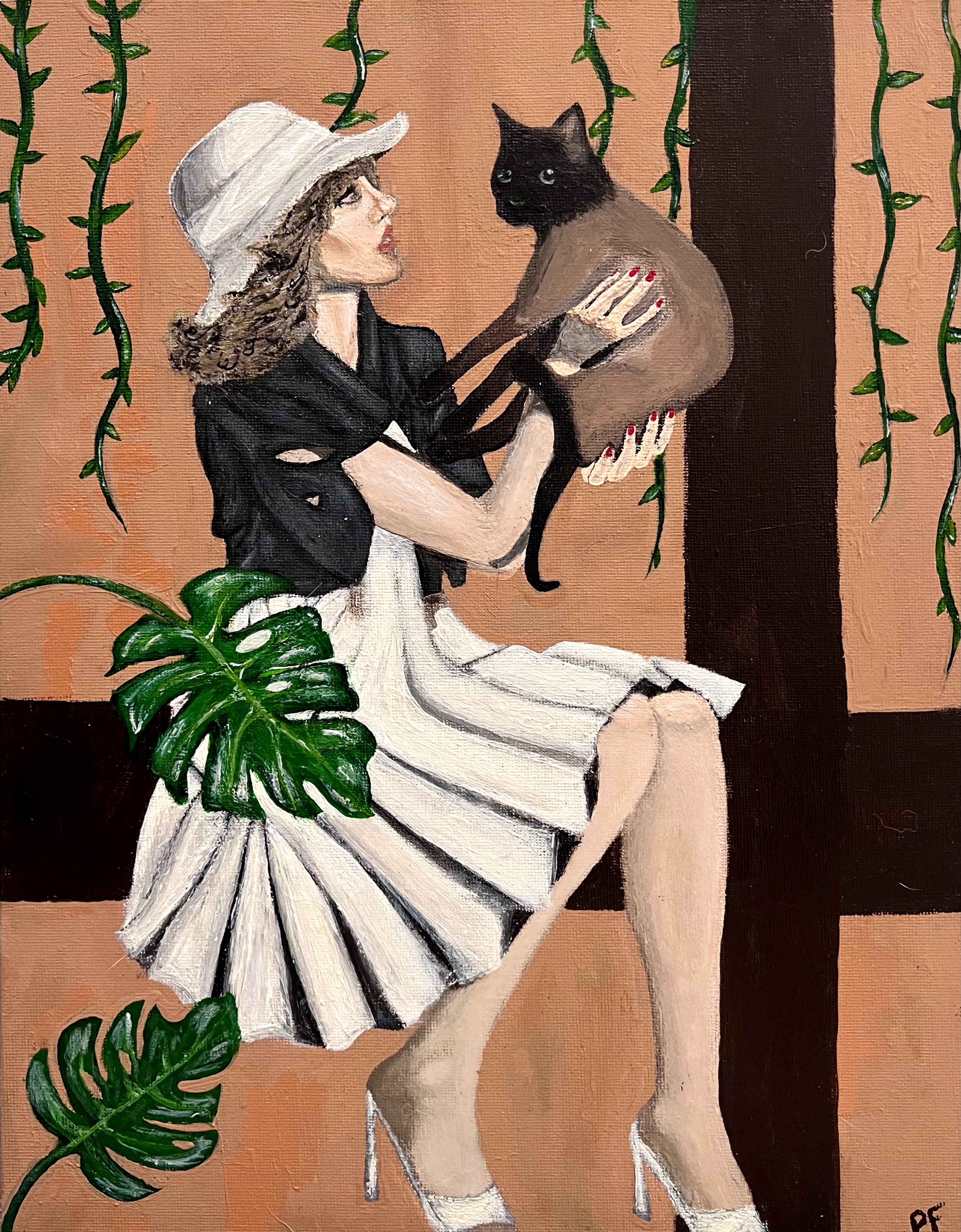
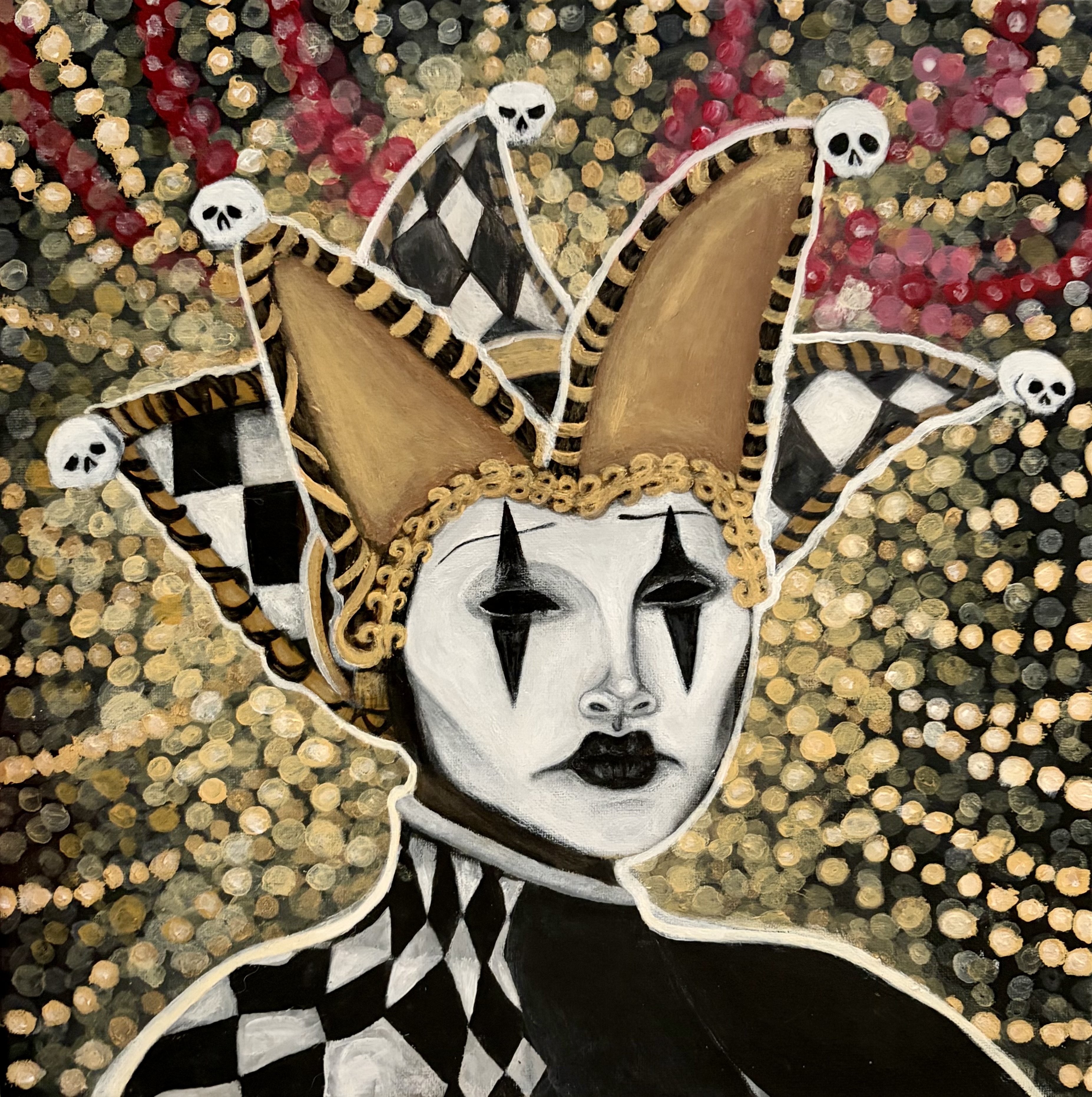
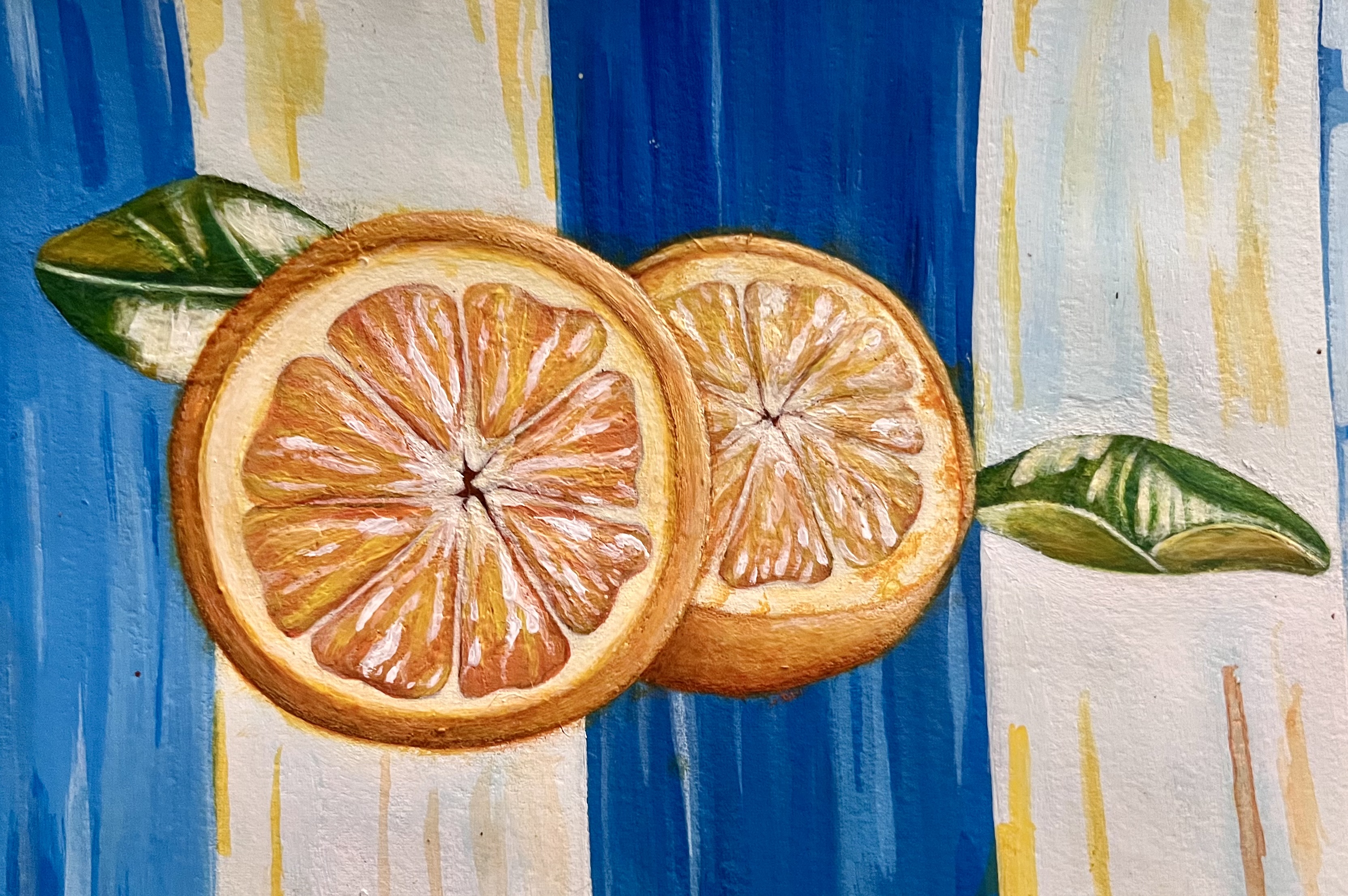
In bible school, I mishear Jonahfor Joan. I picture it—her hairstill perfectly coiffedinside the belly of the beast,sighing, it really is quiet in here.
How she makes this houseof rib and half-eaten sea life, a homefor one. Hanging lanternsof translucent shell, oil drawnfrom within. Sewing herselfa dress, bodice of bone,jellyfish veil trailing behind herin ghostly wisps. Smoothing kelpinto soft rugs where she lies,a quietly humming hymn. She rests
her head on pillows made of grizzled moss.No ticking clocks, no demands for her labor,just the balm of the beast’s belly.
At night, Joan whispers into the tough meatof the whale’s stomach, soft enoughto be heard by flesh, but not by God—please do not send me back.
At the end of three days, Joan finds herselfashore, husband calling her home.The world returns,loud with its claims. She turnsher back on him, like Lot’s wifein reverse, salt licking at her ankles.Moving like the tidetoward a life of her own making.
When I ask my mother about this story,she lets me believe I got it right. She says,only a woman could be swallowed whole and still survive.
I live without making a sound, in an apartment building. We are so crowded. There is nowhere to step. Rooms full of silent people. The elderly, the young, the children. One late afternoon, the expected noise arrives. Overly confident footsteps… Every single step falls into our silence like the sound of a bomb… We don’t even look anymore… At anything. They gather all of us on the bottom floor. The racket made by some of us who dare to look, as they collapse onto the wooden floor, drowns our ears. One of the officers pulls me by my arm, separating me from the silent crowd. He catches the eye of another officer and smirks.
I am afraid. I am always so afraid.
The silence goes completely mute. Now I am alone.
My stomach aches. My stomach always aches. It hurts as if they are gripping it with pliers and twisting it.
Courage; “To the bathroom…?”
A scorpion smirks from the officer’s eyes.
He waits. A deathly silence between the question and the answer. “
Upstairs… go,” he says. The scorpion says this, I know it.
…I am afraid. So much. How can I kill myself… I don’t know.
I go upstairs on the wooden stairs, trying not to make a sound, but my steps on the wooden planks translate my existence to the officer as creaking noises.I dislike the existence of my footsteps. The bathroom is filthy. On the left and right, two exposed toilets. Across from them, a broken and dirty mirror; in front of it, a cracked, clogged sink, filled to the brim with foul water.
How can I kill myself. I don’t know.
The door opens behind me. I knew he would follow me. I see his reflection in the cracked mirror, standing right at my back.
“Sind Sie fertig, Ma’am?”
My voice won’t come out.
He waits. He waits for my fear to grow. He makes no sound at all. If only I could do it in this void, but… How can I kill myself.
I don’t know.
With his large, clumsy hand, he grabs my hair and shoves my head into the foul water in the sink.
I wish I could die in the noise my breath makes in the water. If only he wouldn’t pull my head back out.
“Sind Sie jetzt sauber genug, Ma’am?”
I try to open my eyes; I see blurry for a long time.
“How are you today? Come to my room once the IV is done.”
You are shouting too much. Your disgusting voice feels like it’s exploding my head. And you are the ultimate creep. I hate you. I don’t want to walk to your room. You don’t understand a damn thing. I am uncomfortable with my footsteps.
“Are the new meds better?”
“My stomach aches. My stomach always aches. It hurts as if they are gripping it with pliers and twisting it.”
“Alright? Anything else?”
My voice won’t come out. What fucking good will it do, whatever you write down there. Look at my face when you listen to me. The officer is passing behind you, be quiet.
“What is behind me? Do you see something?”
“…..
I ran into my mother. She hugged me. She was so resentful… I know it. I am not guilty. But I apologized. I gave her flowers. I tried to explain. A man was watching. One of his eyes was white, the other blue. He watched blankly as I explained.
“Then?”
“As I was explaining, I started to vomit. I vomited so much. Onto my mother, onto myself. Everywhere was covered in vomit. …When I was a child, I wanted her to stroke my hair. She could never manage it.”
……
“I used to wait a lot. ….. I am waiting.”
“For what? Please continue.”
….
“What is it that you are waiting for?”
“For what….
She will sleep.
She will sleep forever.
For her to sleep… F
or 1 day. 2… 3… 4… S
he will sleep for days. S
he is sleeping. She told me not to leave this place. She lives for me. She can do it by sleeping a lot. S
he opens her eyes for me every now and then.
—How old am I, mother?
My blank mother. Ice. She isn’t here even when she’s awake.
—You’re 5. Do not leave anywhere.
I am waiting… I am waiting…. I am wait… I wa… wwww…”
I am already so sick of this! I am losing my mind. Don’t you understand? My head is throbbing.
“Please calm down, alright, I understand y—”
You don’t understand a damn thing!
I am going to explode with my rage. My pieces will stick to the white walls of your hospitals. I am gradually liquefying. My form is losing its solid state again. Look at my hands, they are like jelly!
It hurts… Ahhhh. It hurts so much!
“You think it hurts because of fear. What you feel is fear, not pain. Listen to me. There is nothing to hurt you right now. Calm down.”
It hurts so much. Ahhhh!
I am disappearing, save me!
“Nurse! Norodol! Immediately! 10 mg.”
I am on the ferry, on the deck. An angel, with long, wavy hair, so slender… A white dress draped like dust from her shoulders to her ankles… Her back is turned. Her feet are bare on the wooden floor of the deck. Along with the wind, her fine dust scatters around from her shoulders, her hair, her skirts… It is as if the sea is watching her, not she the sea… The wind carries her scent to me; life stops. The ferry stops, the sea stops, the wind stops. The city stops. There is an empty room inside me reserved for this woman, do not lea— She has no face!
You have no face. Your face is a flat, smooth piece of flesh. I feel nauseous… My inside is like mud. I run to the railing, lean over halfway, and vomit. People pass by me, they smell of the day. Every time they get close to me, this smell turns my stomach even more. I am vomiting mud. My reflection shatters in the sea as I vomit. I change shape in the water, I dissolve, I scatter…. In every scattered piece of me, the star-glitters of the sun…
It dazes my eyes. I can only see gleams.
Did I wake up again. Damn it. This will never end. It will never end.
I am tired.
A train passes through the middle of the room. Everywhere is stark white. The train is very fast.
“Shall we get on?”
I step toward the train; it is so fast that I feel drunk. I arrive at a stark white apron. My mother is lying on the ground, in the middle of that huge apron. “I am going to sleep…” she says.
A plane like a woman comes and picks me up… smooth. Heavy. Radiant, gleaming. My mother drifts away, growing smaller and smaller. She is sleeping. I arrive at my home. I go out onto the balcony. Everywhere is spring, sunshine. Pink, lilac colors in the sky. Leaves in every shade of green and yellow… flowers.
It has snowed only on my balcony. My front is winter, my view is spring. The tracks of my steps remain in the snow. I jump into spring from this 10th floor. I see the officer’s feet for a moment, with the roar I hear as I smash into the ground.
“Did you inform the patient’s relative?”
“Unfortunately. Her mother is sleeping, doctor.”
I remember the heft of it first— how it filled the cup of my handlike a winter-worn brickpolished slick by ice and wind,layered with thick cream stock—papered with mink-dark curls, with steady, truthful eyes, with the rough cloaks of awkward villagers,their backs sloped beneath wagon shafts, and the flutter-drooping lids and ivory-carved shoulders of Russian lives—to be thumbed like resolve from preface to endnotes.
On the cardstock cover, creamy skin blushingunder a black beaver kolpak—that dense fur I wanted to touch,to run my fingers through, knowing I could not—framed by Zhivago-white,Anna in snow, the picture of poise—a body balanced on its own center,longing held steady,thought weighed beside action.
I remember my palms splayed wide to hold it open,how I loved her in Moscow,the radiant architectbuilding bridges of forgiveness—who for three hundred pagesmends the lives of those she loves—her mind a room with all the candles lit.
But I avert my eyes,as she takes the hand of Count Vronsky—already knowing where it leads,look down at my wool-stockinged feet,ashamed for her, unable to meet her gaze.I know what’s coming.I know the train is on the track,the candles dimming—I feel the narrowing of every room—her frame no longer ivory.
I insert a rumpled bookmarkwhen the morphine first gets mentioned—and my thumb stops counting pages.Its resolve spent.
I’ve known too many Annas,too many Vronskys—sometimes a boy, sometimes a girl—sometimes a needle, a bottle, or a pill.
A closed book goes on the nightstand. Then the shelf. Then takes the trip to half-priced books—five cents on the dollar—too thick on thin shelves.
Oh, dying hind, teach me how to dress your body
I brought away the choice cuts of your meatThe bubbling belt along the broken chain of your spineYour tender loins, never again to know the stag’s love
What would I do with the rest of you?I softly drew the arrow from your neck
Shaft bent; fletching bloodiedFive-dollar carbon arrow, feathers broken,Abandoned after its first flight
Oh, dying hind, what does it mean to be a man?
For hours, I sat still and silent in the live oakMy fingers, its boughs, both numb with the coldI watched you for a while. I drew back my bow. I wept
How many of your sisters had I let fleeInto the woods? How many of your sons?
Back home, my father awaited my returnYou were not the triumph he wanted for meBut how could I come back to him empty handed?
Oh, dying hind, how can I make my father love me?
His calloused hands guided the hacksawThrough your bones and your sinewsWhile a broken bucket filled with your blood
I wanted to hear his voice praise meWhen we shared the warmth of your flesh
When he stained my cheeks with your bloodWould he look upon me for the first timeAnd see my skin in the shape of a young man?
Oh, dying hind, you are not the first to die at our hands
Our victims slept soundly in the underbrushWhen you woke to the sweet smell of yellow cornDid you not wonder how it gilded the forest?
First, your sisters, then my own; it only takes one deathTo question the warm comfort we find in this violence
The wood becomes a passage between hunt and homeWithout care for the leaves crushed underfootSilences becomes both casualty and weapon
Oh, dying hind, how can we learn to worship and forgive?
My father grinds your legs into sausageYour shoulders into vacuum-wrapped cubesBut you liver and kidneys, your heart and your brain
Will you forgive us for dumping them in the woods?For feeding them to the buzzards and the black flies?
When your meets rots in the freezerBeside the salmon pretending to be a river stoneAnd the frog legs who finally know silence
Oh, dead hind, teach me how to love without violence
Ovid, not every object holds a woman waiting. Not every tree seeks a furnished future. High in the Huon, I am already imagining praise as I dress for desecration. The forest does not stop me. What I find is whole, intact, ready to be shaped, cut, curved. Altar or grave—I am unsure but I have learned that lasting things invite hands. I translate standing into purpose. Bark becomes excess. Stillness becomes error. I pull away strips until the twisting resembles cooperation. This is what craftsmanship means. I call this listening. I shave and plane metal against memory’s rings. Each circle tells me how long it has been preparing for me. Opens like a record. I tell myself to name this discovery. Pale curls fall. Light enters. The surface brightens. This feels like affection. Every cut answers to me and my splendid act of creation. you miss my forest to focus on rings I grew when I felt alive. The blade keens in anger, the grain tightens, curves under the new instruction. I have always corrected what resists me. There is a form inside that needs my hands to finish it. I believe this because my father believed it. We were taught where truth lives. We were taught how to reach into another’s body to find it. I have inherited the certainty that creation requires force. That beauty comes quiet only after I sand away what refuses me. I call it grace. I call it art. I do not question what it was holding itself up for. I carefully assemble the chair. I run my palm along its back. It is warm. I sit. It creaks the way bodies do when they adjust. I shift my weight. It holds. I relax into the success of it. I trust what I have made to know me. So surprised am I when later in betrayal—it gives, when the leg angles just enough, when the balance fails without warning—I am shocked by how this feels. I had shaped this. I had listened. I do not understand where the fault was hiding. I search the break for proof of deception. I have trusted something I shaped to hold me. Where was the fault hidden? I do not recognize my craftsmanship in the fracture. I blame my tools. I refuse to be shaped by this failure. I will not learn that a truth imposed holds no weight at an altar or a grave. I, left now prone and prayer-formed amid my mistake, I have ignored resistance and called it intimacy.
Note: this is ontological erasure—the poem and haiku exist inside the prose and reflects a being that cannot remove itself from its surroundings. Inspiration taken from torrin a. greathouse’s “Burning Haibun” and a line of poetry by Ruby Gross. I am the creator of this form.
The sky is lower in the parts of America reserved for driving, and this weight absolved James of the conscious thought one might experience in the corners of the world, so stuffed with advertisements and elbow maneuvers that it spread alight the kind of thinking he had once freed himself from. The sex hot line billboards were back, less distracting than the strip club advertisements in which the women faced forward. They grazed a few clouds. These women were not real, though in the past few years James had become even more skeptical of their origin, as if they were conjured like false, generated goddesses. He used to picture their middle school teeth in colorful braces, the kinds their parents must have been able to afford to produce such beautiful offspring. But did they have a middle school? Or teeth? Were they born from the long concrete hallways of the computer? The girl in the newest billboard shaded her face with a cowboy hat as the velvet of her back turned coyly. He flicked his eyes back and forth from the road, trying to decipher her nose from the shadow. Too late. And he forgot to wonder further upon his passing, just as all the clouds began to shade a new piece of land, never reminiscent of anything but pure shape.
James selected the least questionable strawberry from his astray of a cupholder and chewed it, stem and all. Spat the stem on the concrete of the Durham truck stop. It looked like a blood clot, the post matter of an abortion. An explanation mark. Stared at its Rorschach. Dreaming nightly, he suffered images in which every bite of food contained a shiny quarter. The homeless men of his dreams ate yogurt containers full of money, while his sister carved into a chicken, erupting silver. Even in sleep he could feel the ridge of the coin’s edge along his tongue, as if he had enjoyed this delicacy hundreds of times and could recount its sensation unthinking.
The only cure, he told himself, is to practice thinking while awake. Still, tanning his left arm on the I-95, the blankness of the sky filled him with calm and even dissolved all the questions he was planning to ask himself while on the road. His memories bored him. He attempted to teach himself whistling, a hobby he had figured to acquire when he began driving, but the sound of the road proved too much to gauge the progress of his air.
Look, he thought, you once knew how to think. Once, knew how to string one thought to the next. I think you were capable of this. Okay, pay attention to the hair on your legs. What does the wind remind you of? Please tell me. Is there anytime you felt like this before? Was the hair always this coarse? Did you ever drive past that Walmart, and did it feel like this too? Or is that one of the newer Walmarts, the ones with the gun racks? Yeah, maybe you stopped at this Walmart for the cigarettes, or maybe that was after you quit but you needed something else. How long has it been since you were here before? Can you retrace the layout of the parking lot? It probably wasn’t winter, you’d remember the ice. So Spring? Were things dying, or just being born?
He did not answer himself back. The billboard over Virginia Southbound advertised motor homes for family living, easy loans, a wide-eyed little boy.
Three hours later, after several instances of remembering to blink in the dry frog of the highway, James pulled into the Parkway Express. He had a cooler-truck, one of those chilled boxes that required the engine to run non-stop to keep the product from melting. Or waking up. He was carrying lobster. And he had carried lobster, twice a week, Maine to Virginia, seen the claws done up with yellow rubber bands. He once transported window panes, hay, gasoline, plastic palettes of box-store toys, consumer built furniture and crates of stone and gravel, but something in the spring urged specialty demand for lobster something exponential. James had heard a rumor that lobster cells could reproduce infinitum without combusting, that they could live forever if only they didn’t outgrow their shells and suffocate their organs. This cruel god was performing experiments.
He recognized some navy boys in front of the mini mart, drinking coffee which stuck to their misshapen beards, dripping.
You drive through Raleigh? Asked a man with a black eye, You hear about the Sex Machine those guys have in the garage? Some greek name I don’t remember. I heard about it before it even made the news, a friend in Pensacola making his way back and forth. Other shit too.
He sniffed a single nostril,
James shrugged.
Yeah, near the woods… He pointed off into the distance, You got a thin face, maybe no one would’ve told you, but look, take that exit one past the military base, you’ll see. It’s a red garage… looks totally fuckin abandoned in the day . Girls are crazy there, all switched around, just go on a Tuesday night. If you’re driving through I mean.
James pretended to ponder this, then picked at the scab below his knee, an injury he could not remember inflicting and which bled its way through the denim. He wanted to properly discuss the act of thinking with this man, whose name was probably Eddie and who had once, in some other chance encounter, regaled to him the various Hell’s Angels Intuition rituals. Go down on some chick while she’s on her period, he had said, then lick all the blood from the folding chair, in front of her husband and all, and you gotta enjoy it to, or look like it at least. James had said nothing in response. Maybe it was just the look on his face, the taste of salt in his mouth from chewing on some salve for his fixation, which had caused Eddie the conversation to
You see, Black-eyed Eddie continued, gas is expensive, skies are all yellow-tinted — the government isn’t hiding anything from us, no, they’re showing it, just hoping we won’t pay attention. I see families driving, the kids are staring at the phones. Everyone’s watching the news, they’ve got it on all the time, Dolores at home too, she just watches like a.. I’m not sure, like she’s got dementia and it’s the only window. They’re gonna use the new plague to make us sterile, and then the chicks will replace us with.. Well, I don’t remember the name but whatever typa thing they’ve got in Raleigh. Like a rocking horse, that’s gonna be the end of humanity.
Then he saluted, turned inward to the laughter of the others. James hesitantly saluted back.
The sunrise was diluted by the painful claustrophobia of traffic. James wanted to smoke menthol, wanted to punch the horn through the steering wheel. He had spent the night dreamless, save for a strange metal taste in the mouth which followed him everywhere now, bright and inhuman. There were no billboards in Arlington county, just the tall white sheath of the Washington monument, like a missile ready to launch at any moment.
He was familiar now, after several weeks of latent, answerless uncertainty, with the Pentagon security clearance customs; first, he excavated his electricity bill from his glovebox, and then his driver’s license, placed the 45 in the passenger seat, despite its lack of bullets. Fished for the registration too, then the order invoice. And then he waited. Radio waves were blocked at the receiving entrance, and even though he rarely listened to the radio, it bothered him that someone would have such jurisdiction over the flow of energy. All he could pay attention to was the taste, insufferable, as if it began at the base of the spine, as if it was a kind of pain. Don’t look too nervous, the logistics manager at the warehouse had told him, they’ll search the whole vehicle. It’s protocol, standard. But the taste… the wires of James body jumped, marionettelike. He slammed open the truck door.
He blamed the Hell’s Angels, and he blamed the dream, blamed the waifish woman who refused to even show her face. He remembered, in the manner of what he considered miracle, the phone number beside her pale body. He opened the box of the truck, the metal door lifting like a dull sun in the concealed receiving port. The lobsters sat motionless. He dialed the number, a brief tone immediately cut off by lack of signal. The lobsters stared at him in an unconscious mass. He grabbed the nearest one with tepid strength and scraped the eggs from its underside, shoveling them into his mouth, using the edges of his teeth to scrape excess from under his fingernails. He held it over his mouth, as if devouring some meal, some collection of gaudy jewels or marbles, a child attempting to fit as much as it can in its growing jaws. When the heat of his hands stirred the lobster to life, he dropped it with a thud, and moved onto the second. Inhaled deeply, desperate to stir some transformation, of taste, of thought.
A knock on the metal. A man in digitized camouflage fatigues watched as James pressed his nose to the underside of the lobster, a fat blue creature beginning to squirm.
Is this the shipment of lobster?
James nodded and set down, with realized autonomy, the last of his conquests.
Do you have the necessary paperwork for the shipment?
In the front, James said. I can come around and show you. I have a registered firearm present on the passenger seat.
The man in fatigues waved his arm in unexpected nonchalance. And the invoice is paid?
Yes.
The soldier stood steady, looking upwards. James did his best to not look sheepish, wanting to apologize for the few creatures still moving, and wanting to apologize to them, as they buzzed in confused circles. He moved to the driver’s seat as more teenagers in fatigues descended upon the lobsters, carrying them in uniform lines, stacking palettes of the lobsters onto dollies pushed by two men at a time.
You’re good to go, the soldier told him, the box is empty.
James merged onto the highway, into the stream of cars, who, like him, felt merely the insidious presence of power, unable to name it. He used his tongue to excavate the last of the eggs from his back molars. The radio jumped back to life, mid song, quickly becoming no different than silence as his attention waned. He had lost all faith in noticing.
How did they know, he wondered, about the infinite nature of the lobster cell?
He tried to imagine the woman’s face behind the cowboy hat, the anchor of her nose. Her teeth in braces. He couldn’t.
He was still drunk when he wrote it-Slouched on one elbow in his mother’s kitchen,Sharpie bleeding through the white lace tablecloth,the number in a lopsided heartthat was loose at the tip–A note the size of a child’s palm,triple-stapled to the pole at the cornerof Divine and Marketwith the staccato of nothing-to-lose.He guessed at the spelling,wrote it with a y like the girl from his high schoolband, hot as a French horn,her legato, his libido–He guessed almost everything about her.Honestly couldn’t describe her face,hoped she’d turn right when she left the buildingto catch the 66, buy a scratcher at Tak,hustle to hot yoga, light a spliff–whatever, anything, just turn–He had shattered almost everything thatwasn’t handed to him broken,arms laced with scars from jagged edges.She looked him in the eye, strummedthe curve of her hip against his thigh(the bar too crowdedto avoid these duets)She told him her nameAnd for a moment he matteredto someone other than Godwho was not that much fun on a Saturday night.He sleeps it off at Mom’s.She does not see the noteHe rejoins invisibilityShe does not remember his touch.An alternate coda:She wakes, bleary and dry-mouthed,vibrating with loneliness,goes down to buy a coffee she cannot afford
at the corner where the universehas left her a sign
She always knew too latewhen the epeleptic devil was on her heels:she froze in the seizure foreknown the shreddedmorning her memory flapping like a sheetsuddenly rotten ripped in strips that all could seestrewn through fifty miles of bare-limbed trees.Surprise surprise she’d soon become a namelessrag-o-bones of the Grand Mal mouth of pink foamkicking spitting on the floor of the lockered hall.
But on those Friday nights when she twirled,her batons turned into pure platinum wheelsdislodged from the chariot of Zeus.She ripped them off from Olympus broughtdown to the fifty-yard line her wildest loot.We saw her on the football fieldblur those hammered wandsin the sky sailing above the stadiumglare she spun them into rare iridium.
The demons fled that classic alchemy,the Father of the Muses reclinedenthroned with patience for his wheels’ return.And everyone in the distant bleacherssomehow knew her theft was hardest earned.The crowd of locals roared with wolf whistlesas our girl smacked and kicked aroundthe Maker of Surprise. She tossed her nearlyperfect revenge of nearly perfect balanceinto a greater dark where she could notpossibly see it whirl above the field lights.But as is destiny it came back spinning downand she would sweep it by its tail and let it flyagain to evaporate into the atmosphere unboundunknown where only moon could make it sparkle.Where did it go? It seemed to hang for yearswhile she waved to us in momentary cavalier.It came spinning down with her laughingup at the big lights tricked to make it most unclear--surprise surprise she never let it hit the ground.
Keys, wallet, phone.The Collected Works of Federico García Lorca.Moleskin journal and ballpoint pen.Mahogany chess board, Rubik’s Cub, and a framed photoof your grandfather posing with Edward R. Murrow.Comfortable shoes, down jacket rated to 38,000 feet.Wings and feathers; compass, ice axe, rope.Map of the Earth and, in case of emergency, of the stars.A lifetime supply of guitar strings, guitar not included.Bathymetric chart of the sea, mastery of whale-song.Gifts for the people of Atlantis and Xanadu.Your share of stolen jewels from the Louvreand a list of paupers to hand them to.Lock of Whitman’s beard, pailful of sandfrom Omaha Beach, Normandy, 1944.Ice sculpture of the Lincoln Memorial, signed copyof the Gettysburg Address.Graph of the Keeling Curve as of November 2nd, 2025.Sword in the Stone, sword of Damocles.Candles, incense, life-size statue of Avalokiteshvara–his Thousand Hands soothing, just enough,your megalomania.
Liam Simonelli is a cartoonist and illustrator based in New Jersey. He holds a BFA specializing in Graphic Design from The College of New Jersey. His work has been featured in numerous publications, including The Washington Post, Politico, The Star-Ledger, The Tampa Bay Times, and The Staten Island Advance. He received the 2022 National Mark of Excellence Award in Editorial Cartooning from the Society of Professional Journalists and is a member of the Association of American Editorial Cartoonists.
Georgia born and raised, Michaela A. Reed is a fiction and poetry writer whose work invites readers into a world in which the cosmic and the domestic play side by side to unearth memory and emotion. She holds an MFA in Creative Writing from Georgia College & State University, and her work has appeared in Cottonwood literary magazine and River & South Review.
Cortnie B Duran lives in Denver, Colorado, and Cozumel, Mexico. She is a social worker focused on the safety and stability of unhoused women, trans, and non-binary people. Her work has appeared in journals including Under the Sun and Honeyguide, and her essay “Where Are You Going?” was nominated for a Pushcart Prize.
Erica Miriam Fabri is a Brooklyn-based poet and the author of two books: Morphology (Write Bloody Publishing) and Dialect of a Skirt (Hanging Loose Press). Morphology won the Jack McCarthy Book Award, and Dialect of a Skirt was a finalist for the Paterson Poetry Prize. She teaches writing at Pace University and the College of Staten Island. This poem is from a forthcoming manuscript, Struck by the Moon.
Logan McDermott-Mostowy is a DC-based educator and librarian. His work has previously appeared in the literary journal Lilac Peril and in a sonnet anthology from Quillkeepers Press. He was a 2025 resident at Sundress Academy for the Arts in Knoxville, TN.
Daniela Dragas is a word lover, memory keeper, and writer. Her debut novel, Visitations, was published in 2025, and her writing has appeared in various magazines and journals. She holds an MA (with Distinction) in Creative Writing from the International Institute of Modern Letters, Victoria University of Wellington. Daniela grew up in Zagreb and currently divides her time between Zagreb and Wellington.
Amuri Morris is an artist based in Richmond, Virginia. She recently graduated in painting and printmaking from Virginia Commonwealth University. She has received several accolades, including a Virginia Museum of Fine Arts Fellowship, and has participated in over a dozen exhibitions.
Emma Johnson-Rivard is a doctoral student in creative writing at the University of Cincinnati. Her work has appeared in Strange Horizons, Tales to Terrify, Red Flag Poetry, and others. Her poetry chapbook, mice inherit apocalypse, is forthcoming from Finishing Line Press.
Jasmine Games (she/they) is a poet, theatre maker, and educator based in Austin, Texas. She is the author of Somebody's Daughter (Black Spring Press Group, 2024), winner of the 2021 Sexton Prize, and the Co-Executive Director of The Poet House. Her work has been performed and published across stages and pages nationally. This poem is part of a larger choreopoem manuscript, Something in Me About the Ground.
Katharina Barrett writes poems that don't perform gratitude. A late-blooming, queer and neurodivergent poet with a suspicious eye and a good memory, she is interested in power, inheritance, sex, religion, and the fine print of family lore. She works in Northern California and also makes mixed-media art under the name Baroque Grunge. Her work is forthcoming in The Brussels Review.
Khalil Elayan is a Senior Lecturer of English at Kennesaw State University, teaching mostly World and African American Literature. His other interests include writing short stories and spending time in nature on his farm in north Georgia. His poems have appeared in Snapdragon Journal, The Black Fork Review, About Place Journal, and The Esthetic Apostle. His recent poetry book, Of Meadows and Echoes, was published by Kelsay Books.
J.E. Safa is a first-generation Lebanese-American writer born and raised in Brooklyn, New York. Her poems, essays, and short stories have appeared in The Esthetic Apostle, Coffee & Crumbs, Rusted Radishes, Running Wild Press, The Petigru Review, and elsewhere. She was nominated for a Pushcart Prize for her short story “In the Heart of Mama's Belly.” She splits her time between Brooklyn and Myrtle Beach, South Carolina, and also publishes under Joujou and Jawaher.
Peyton Fultz is an emerging acrylic painter hailing from the DC area.
Delores Amorelli is a medical educator and an emerging poet with work published in Beyond Words, Half and One, Black Horse Review, and Cathexis Northwest. She lives in Los Angeles with her rescue dog, Blossom. Through poetry, she examines the spaces between loss and reclamation, harm and healing, and how memory lingers in the body.
Nihan Şakar is a literary translator and writer holding a degree in English Language and Literature. Based in Oxford, UK, she has translated over 40 published literary, philosophical, and poetic works, with a focus on counter-culture, dark surrealism, and underground literature, including works by William S. Burroughs, Mary Shelley, and the art of Leonora Carrington. Her creative writing navigates the intersections of trauma, fluid consciousness, and atmospheric realism.
Casey Goodall came to poetry after a life in other kinds of work: a farm childhood in rural Utah, naval service, school district administration, years as an adjunct professor and dissertation advisor, and six years as an amateur photographer. His poems move between memory, moral attention, the natural world, and philosophical inquiry, often through specific sensory experience.
CS Crowe is a poet and storyteller from the Southeastern United States. He believes stories and poems are about the journey, not the destination, and he loves those stories that wander in the wilderness for forty years before finding their way to the promised land. These poems are from his chapbook, The Persistence Hunter.
Rhys Anderson is an agender poet from Lutruwita, currently living in Berlin, where Rhys organises for Berlin Spoken Word, Outside The Lines Slam, Petty Slam, Body Slam, and Florets Magazine. Rhys receives gender euphoria from writing artist bios in the third person and can be found in Beyond Queer Words, Scapegoat Review, MIDLVL Mag, Culture Shock, and Eunoia Review.
Caroline Clair McDonald is a writer from Southern California. She is the editor of commodity fetish magazine and co-founder of the Not For Leisure reading series. Her previous work appears in Stone of Madness Press, ChewGUM ONLINE magazine, and several online publications. She believes in ontology.
Karen White has been quietly writing for more than 30 years while presenting as a product manager and coach in Silicon Valley tech. She lives with her wife and two soporific cats in San Jose, California, where she practices Zen and rides her bicycle everywhere it will take her, searching for poems.
Holly Hunt lives and writes poems, essays, and fiction in Hot Springs, Arkansas, with her genius cat and her husband who was raised by wolves and The Grateful Dead in northern California. Her poetry has appeared in Poetry, Ploughshares, The Southern Review, Anti-Heroin Chic, and others.
Andy Posner grew up in Los Angeles and earned an MA in Environmental Studies at Brown. While there, he founded Capital Good Fund, a nonprofit that provides financial services to low-income families. When not working, he enjoys reading, writing, watching documentaries, and ranting about the state of the world. His poetry has been published in numerous journals, including Burningword Literary Journal (which nominated his poem ‘The Machinery of the State’ for the Pushcart Poetry Prize).